

Zambon
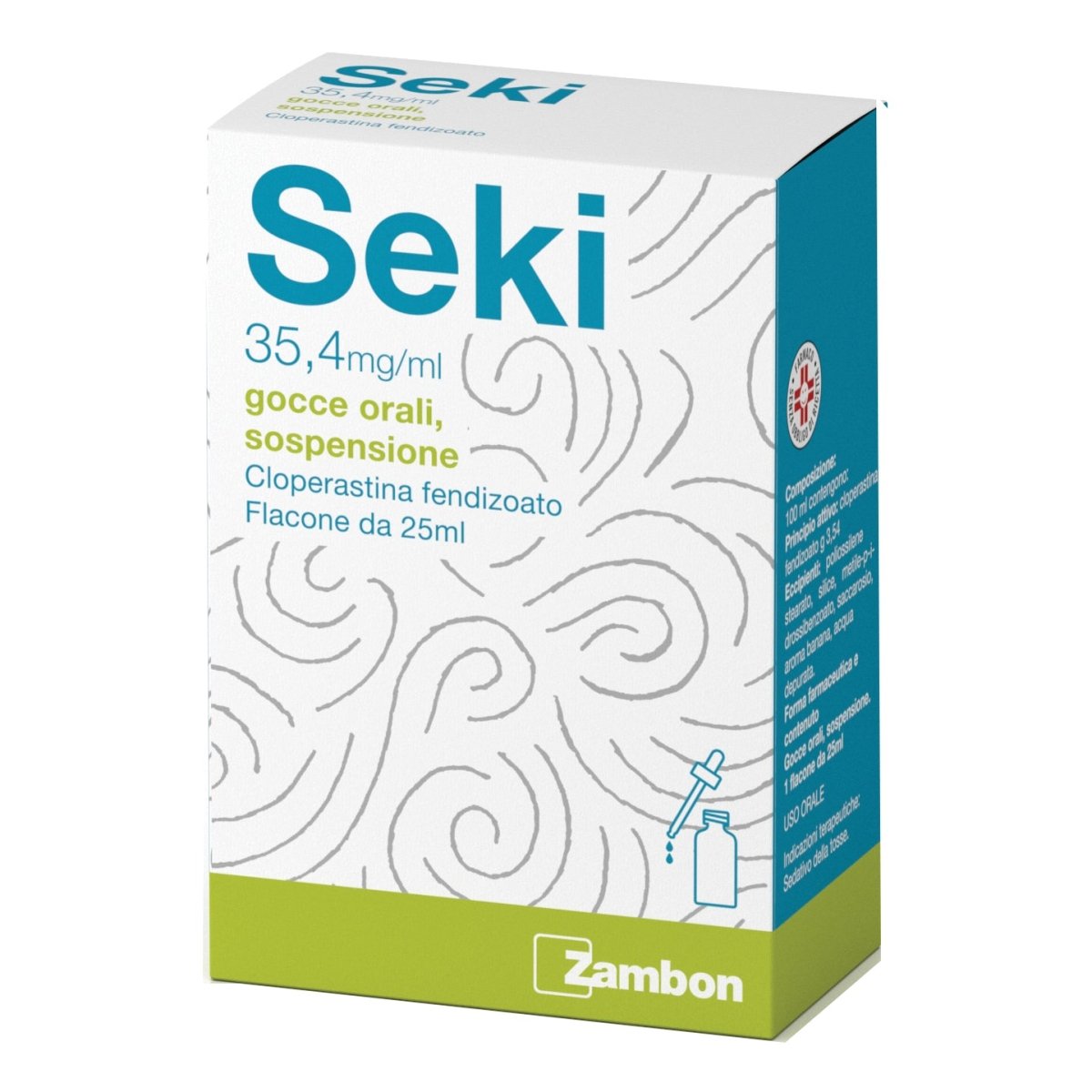
Seki 35.4 mg/ml 25 ml oral drops suspension
Seki 35.4 mg/ml 25 ml oral drops suspension
Couldn't load pickup availability

NET WEIGHT OF THE PRODUCT
NET WEIGHT OF THE PRODUCT
25ml
EAN
EAN
024427054
MINSAN
MINSAN
024427054
In ottemperanza all'articolo 118 “autorizzazione della pubblicità presso il pubblico” del decreto legislativo 24 aprile 2006, numero 219
INDICATIONS
Cough suppressant.
ACTIVE INGREDIENTS
SEKI 10 mg coated tablets One tablet contains: active ingredient: cloperastine hydrochloride 10 mg; excipient with known effect: sucrose 38.07 mg.SEKI 35.4 mg/ml oral drops, suspension 100 ml contain: active ingredient: cloperastine phendizoate 3.54 g equal to cloperastine 1.8 g; excipients with known effects: sucrose 14 g, methyl-para-hydroxybenzoate 0.2 g. 1 drop (equivalent to 0.05 ml) contains 1.8 mg of cloperastine phendizoate equal to 0.9 mg of cloperastine. SEKI children 4.4 mg chewable tablets One tablet contains: active ingredient: cloperastine phendizoate 4.4 mg; excipient with known effect: sucrose 36.8 mg. For the full list of excipients, see section 6.1
EXCIPIENTS
SEKI 10 mg coated tablets microcrystalline cellulose, silica, talc, magnesium stearate, hypromellose, povidone, macrogol 4000, sucrose, magnesium carbonate, titanium dioxide, erythrosine (E127). SEKI 35.4 mg/ml oral drops, suspension polyoxyethylene stearate, silica, methyl parahydroxybenzoate, sucrose, banana flavor, purified water. SEKI children 4.4 mg chewable tablets sucrose, mannitol, microcrystalline cellulose, starch, methylcellulose, magnesium stearate, talc, strawberry essence.
CONTRAINDICATIONS AND SIDE EFFECTS
Hypersensitivity to the active substance or to any of the excipients listed in paragraph 6.1. Due to the absence of studies in early childhood, the medicine is contraindicated in children under 2 years of age.
DOSAGE
Daily dose: ADULTS: Coated tablets: 2 tablets in the evening at bedtime; 1 tablet in the morning, 1 tablet in the afternoon, preferably between meals. Drops: 30 drops in the evening before bedtime, 15 drops in the morning, 15 drops in the afternoon. CHILDREN over 2 years old: Chewable tablets: up to 7 years: 2 tablets in the evening at bedtime; one tablet in the morning; one tablet in the afternoon. After 7 years: 4-6 tablets in the evening at bedtime; 2-3 tablets in the morning; 2-3 tablets in the afternoon. Drops: 14 drops in the evening before bedtime, 8 drops in the morning, 8 drops in the afternoon. Duration of treatment: 7 days. If you do not notice appreciable results, it is advisable to consult your doctor.
CONSERVATION
Drops and chewable tablets: this medicine does not require any special storage conditions. Coated tablets: store below 25°C.
WARNINGS
Caution is advised when using it in patients suffering from intraocular hypertension, prostatic hypertrophy or bladder obstruction. Important information about some excipients Parahydroxybenzoates The drops contain methyl-para-hydroxybenzoate (E218) which may cause allergic reactions (even delayed). Sucrose - the coated tablets contain 38.07 mg of sucrose per dose; - the chewable tablets contain approximately 36.8 mg of sucrose per dose; - the drops contain approximately 140 mg of sucrose per ml. Patients suffering from rare hereditary problems of fructose intolerance, glucose-galactose malabsorption or sucrase isomaltase insufficiency should not take this medicine. In the case of diabetics or those following low-calorie diets, it should be kept in mind that the preparation contains sugar.
INTERACTIONS
Although the central side effects of cloperastine are reduced, the medicine can interact with both central nervous system depressants and stimulants. No interaction studies have been conducted on humans. It is not recommended, both in adult patients and in children, the concomitant use of Seki with: - alcohol; - antihistamines; - anticholinergics; - sedatives. It is not known whether in pediatric age the extent of the interactions reported above is similar to that in adulthood. There is no information regarding any interactions of the drug with laboratory tests. No information is available regarding the interaction of cloperastine with food, therefore its intake during meals is not recommended.
SIDE EFFECTS
Below is a table relating to the frequency of side effects: Frequency: very common (≥ 1/10); common (≥ 1/100, < 1/10); uncommon (≥ 1/1000, < 1/100); rare (≥ 1/10,000, < 1/1,000); very rare (< 1/10,000), not known (frequency cannot be estimated from the available data). Within each frequency grouping, undesirable effects are presented in order of decreasing seriousness.
System organ class - Adverse reactions: Uncommon (≥1/1,000; <1/100). Rare (≥1/10,000; <1/1,000). Very rare (<1/10,000). Not known.
Immune system disorders - Anaphylactic/anaphylactoid reaction.
Nervous system disorders - Adverse reactions: Drowsiness, dry mouth.
Skin and subcutaneous tissue disorders - Urticaria Erythema.
Pediatrics Clinical studies and post-marketing surveillance with cloperastine have not shown any relevant differences in the nature, frequency, severity and reversibility of adverse reactions between adult and pediatric populations. Reporting of suspected adverse reactions Reporting suspected adverse reactions that occur after authorization of the medicine is important, as it allows continuous monitoring of the benefit/risk balance of the medicine. Healthcare professionals are asked to report any suspected adverse reactions via the national reporting system at https://www.aifa.gov.it/content/segnalazioni-reazioni-avverse.
OVERDOSE
Adults No cases of overdose have been reported in adults treated with Seki. Children One case of overdose has been reported in a child who took a dose of 40 ml of Seki syrup. No associated adverse reactions were reported. The patient was treated with two tablespoons of activated charcoal. Treatment of overdose Gastric lavage is useful if performed within a short time of ingesting the drug. The patient must be kept calm to minimize any sign of central overexcitation: in this case the use of benzodiazepines can be useful.
PREGNANCY AND BREASTFEEDING
Pregnancy There is no information available regarding the use of Seki during pregnancy. Although toxicity studies carried out during pregnancy in animals have not shown teratogenic activity and foetotoxicity, it is good prudential practice not to take the drug in the first months of pregnancy and in the subsequent period only in case of actual need under the direct supervision of a doctor. Breastfeeding It is not known whether the medicinal product and/or its metabolites are excreted in breast milk; Since the risk to the infant cannot be excluded, Seki must not be used during breastfeeding.
EFFECTS ON DRIVING ABILITY
Since the product can, although rarely, cause drowsiness, those who may drive vehicles or carry out operations requiring a high degree of vigilance must be warned of this.
OUR PRODUCTS FOR THIS SEASON
-
Curial βeta Dry eye supplement 30 capsules Dr.Tili
Vendor:TilpharmaRegular price €22,50Regular priceUnit price per€22,50Sale price €22,50 -
T - Relaxfast Sleep Supplement 60 Capsules Dr.Tili
Vendor:TilpharmaRegular price €24,50Regular priceUnit price per€24,50Sale price €24,50 -
Face Serum C5 Vitamin C 30ml Dr.Tili Skinlab
Vendor:TilabRegular price €62,50Regular priceUnit price per€62,50Sale price €62,50 -
Dr.Tili Skinlab E15 Vitamin E Face Serum 30ml
Vendor:TilabRegular price €32,50Regular priceUnit price per€32,50Sale price €32,50 -
Vit+ Face Vitamin Cream 50ml Dr.Tili Skinlab
Vendor:TilabRegular price €34,00Regular priceUnit price per€34,00Sale price €34,00 -
Anti-aging Facial Treatment Hyaluronic Acid IAL B3 30ml Dr.Tili Skinlab
Vendor:TilabRegular price €46,00Regular priceUnit price per€46,00Sale price €46,00 -
Body Milk Hydra Milk 200Ml. Dr.Tili Skinlab
Vendor:TilabRegular price €16,90Regular priceUnit price per€16,90Sale price €16,90 -
Facial Cleansing Milk 150ml Dr.Tili Skinlab
Vendor:TilabRegular price €18,90Regular priceUnit price per€18,90Sale price €18,90 -
Soothing Facial Toner 125ml Dr.Tili Skinlab
Vendor:TilabRegular price €14,50Regular priceUnit price per€14,50Sale price €14,50 -
Soothing Face Cream 50ml Dr.Tili Skinlab
Vendor:TilabRegular price €19,50Regular priceUnit price per€19,50Sale price €19,50

















-

ASSISTANCE - TELEPHONE ORDERS
-

SHIPPING
Shipping to Italy 24/48H
Delivery also on Saturday and Sunday
Free over €49.90
Shipping to Europe 24/72H
Free over €80 -

SAFETY
The security of your data is important to us!
We strictly comply with the European GDPR regarding
Privacy and processing of personal data
The payments you make on our site are 100% safe and guaranteed -

RETURNS
Fast returns via DIY portal and 14 days to change your mind.
Immediate and free replacements for incorrect or non-compliant products delivered.


