

Chiesi
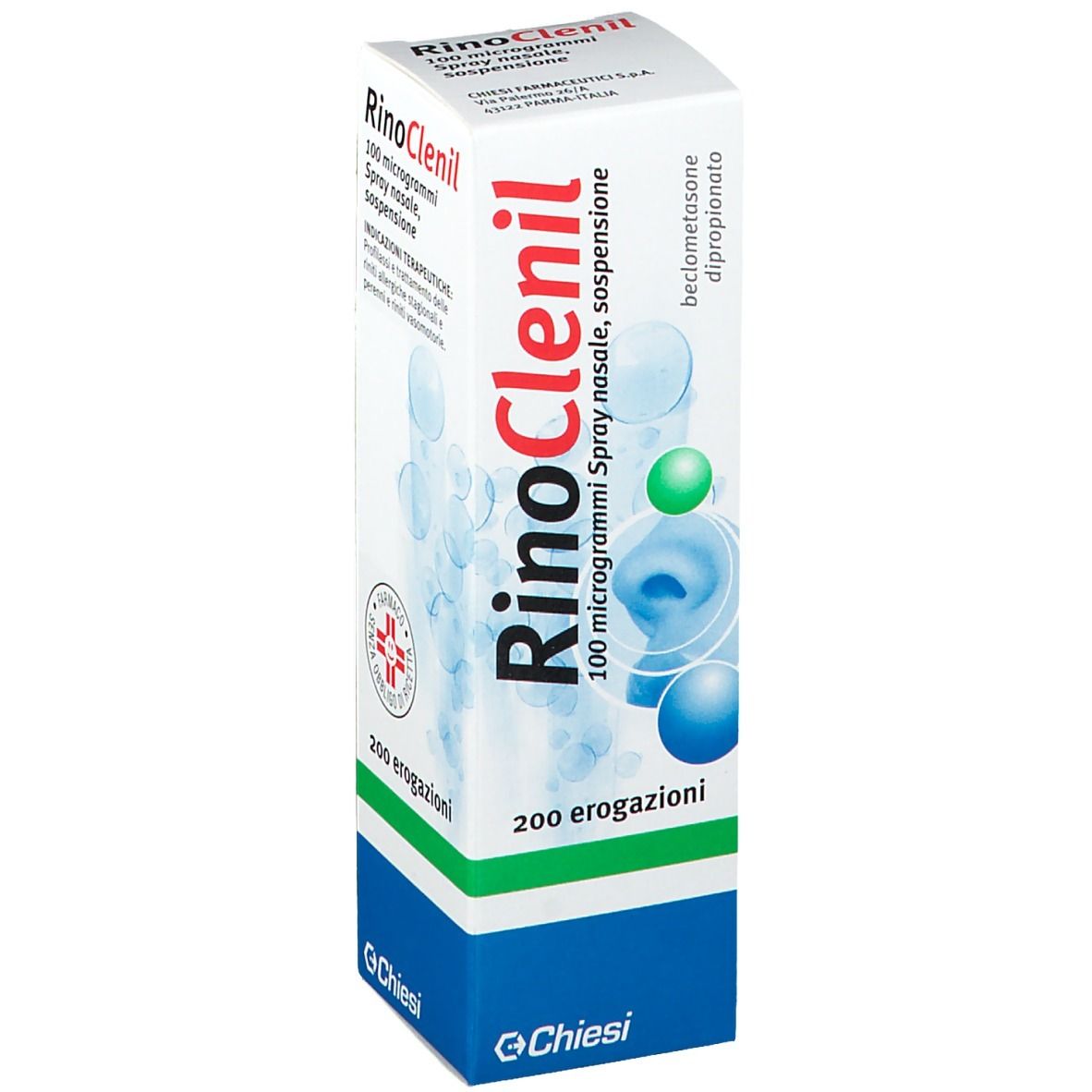
Rinoclenil 100 µg 30 ml nasal spray suspension (200 sprays)
Rinoclenil 100 µg 30 ml nasal spray suspension (200 sprays)
Couldn't load pickup availability

NET WEIGHT OF THE PRODUCT
NET WEIGHT OF THE PRODUCT
30ml
EAN
EAN
035799028
MINSAN
MINSAN
035799028
In ottemperanza all'articolo 118 “autorizzazione della pubblicità presso il pubblico” del decreto legislativo 24 aprile 2006, numero 219
INDICATIONS
Prophylaxis and treatment of seasonal and perennial allergic rhinitis and vasomotor rhinitis.
ACTIVE INGREDIENTS
100 ml of suspension contains: Active ingredient: Beclomethasone dipropionate 77 mg. Each spray delivers 100 micrograms of beclomethasone dipropionate. Excipients with known effects: Benzalkonium chloride 27 mg. For the full list of excipients, see section 6.1.
EXCIPIENTS
Polysorbate 20, microcrystalline cellulose and sodium carboxymethylcellulose, benzalkonium chloride, phenylethyl alcohol, dextrose (glucose) monohydrate, purified water.
CONTRAINDICATIONS AND SIDE EFFECTS
Hypersensitivity to the active substance or to any of the excipients listed in paragraph 6.1; Local viral and tuberculosis infections; Contraindicated in children under 6 years of age.
DOSAGE
Rhinoclenil should be administered exclusively via the nasal route. Dosage Adults and children over 6 years old: two sprays in each nostril once a day. In children, if deemed appropriate, a divided dose administration schedule can be maintained, carrying out a single delivery into each nostril twice a day. The onset of the effect is not immediate and for complete therapeutic benefit it is advisable to use the product regularly and for several days. Children under 6 years old: the product must not be administered to children under 6 years of age. Method of administration Shake the bottle vigorously before each administration. Furthermore, before starting the therapy it is advisable to remove the protective cap and the protection ring and activate the dosing pump several times to start the nebulization mechanism. Proceed with dispensing as follows: 1) Carry out a thorough cleaning of the nose. 2) Remove the protective cap. 3) Remove the protection ring that blocks the pump from the side. 4) Hold the bottle between your fingers. To put the nebulization mechanism into operation, operate the dosing pump several times until you obtain a visible spray. 5) Place the nasal nozzle on one nostril, closing the other nostril with a finger. Inhale and press the base of the nasal nozzle at the same time. In this way, a precisely metered single dose of the active ingredient is delivered. Repeat the same operation on the other nostril. 6) After use, replace the protective cap and the protective ring. If the dispenser becomes blocked, wash it carefully with warm water, without touching the hole with sharp objects.
CONSERVATION
This medicinal product does not require any special storage conditions.
WARNINGS
Systemic effects may occur with intranasal corticosteroids, particularly when prescribed in high doses for prolonged periods. In any case, treatment must be suspended and appropriate therapy instituted. Such effects are less likely to occur than with treatment with oral corticosteroids and may vary in individual patients and between different corticosteroid preparations. Possible systemic effects include Cushing's syndrome, Cushingoid features, adrenal suppression, growth retardation in children and adolescents, decreased bone mineral density, cataracts, glaucoma and, more rarely, a range of psychological or behavioral effects including, sleep disturbances, anxiety, depression or aggression (particularly in children) or neurological effects such as psychomotor hyperactivity. It is recommended to regularly monitor the height of children receiving prolonged treatment with intranasal corticosteroids (see section 4.8). Although RINOCLENIL controls the symptoms of allergic rhinitis in most cases, an abnormally high stimulus of allergens may in certain cases require appropriate additional therapy, in particular to control ocular symptoms. The replacement of systemic corticosteroid therapy with topical corticosteroid therapy (Rinoclenil) requires caution, especially where there is reason to believe that a certain degree of impairment of adrenal function is present. In particularly sensitive or predisposed subjects due to recent therapies with systemic steroids, or if doses of nasal beclomethasone are taken in excess of what is recommended, systemic effects may occur (osteoporosis, peptic ulcer, signs of secondary adrenal insufficiency). Visual disturbances Visual disturbances may be reported with the use of systemic and topical corticosteroids. If a patient presents with symptoms such as blurred vision or other visual disturbances, referral to an ophthalmologist should be considered for evaluation of possible causes which may include cataracts, glaucoma, or rare diseases such as central serous chorioretinopathy (CSCR), which have been reported after the use of systemic and topical corticosteroids. Rhinoclenil should not be used after trauma or surgery to the nose (until healing) and in the presence of nasal ulcerations, unless prescribed by a doctor. In patients being treated with systemic corticosteroids, the product must be administered under medical supervision. Do not use for more than a month without consulting your doctor. Excessively prolonged use of topical corticosteroids can cause temporary suppression of the hypothalamic-pituitary-adrenal axis, causing secondary adrenal insufficiency. Infections of the nasal passages and paranasal sinuses must be treated appropriately, however they do not constitute a specific contraindication to the use of Rinoclenil. Warnings relating to excipients The product contains benzalkonium chloride, an irritant that may cause local reactions. Benzalkonium chloride (BAC) contained as a preservative in Rinoclenil, especially when used for long periods, can cause swelling of the nasal mucosa. If such a reaction (persistent nasal congestion) is suspected, a medicinal product for nasal use without BAC should be used, if possible. If such medicinal products for nasal use without BAC are not available, another pharmaceutical form should be considered. May cause bronchospasm.
INTERACTIONS
Beclomethasone is less dependent on CYP3A metabolism than other corticosteroids and, in general, interactions are unlikely; however, since the possibility of systemic effects cannot be excluded with the concomitant use of strong CYP3A inhibitors (e.g. ritonavir, cobicistat), caution and appropriate monitoring of the use of such agents is recommended.
SIDE EFFECTS
Systemic side effects are extremely unlikely due to the low doses used. Systemic effects may occur with intranasal corticosteroids, particularly if prescribed in high doses for prolonged periods. These can include growth retardation in children and adolescents. However, particular caution must be exercised in prolonged use of the product, keeping the patient under observation in order to promptly reveal possible systemic effects (osteoporosis, peptic ulcer, signs of secondary adrenal insufficiency). As with other nasal preparations, burning sensation, irritation, dryness and, more rarely, epistaxis may occur locally. Rare cases of nasal septal perforation have been reported following nasal applications of corticosteroids. Rare cases of increased intraocular pressure or glaucoma have been associated with formulations of beclomethasone dipropionate for nasal application. Cases of blurred vision have been observed with unknown frequency (see also section 4.4). In case of infection, institute appropriate therapy. Reporting of suspected adverse reactions Reporting suspected adverse reactions that occur after authorization of the medicine is important, as it allows continuous monitoring of the benefit/risk balance of the medicine. Healthcare professionals are asked to report any suspected adverse reactions via the national reporting system at: www.aifa.gov.it/content/segnalazioni-reazioni-avverse..
OVERDOSE
Administration of large quantities of beclomethasone dipropionate over a short period of time may result in suppression of hypothalamic-pituitary-adrenal function. In this case, the dose of RINOCLENIL should be reduced immediately to the recommended dose.
PREGNANCY AND BREASTFEEDING
Pregnancy In pregnant women, the product should be administered in cases of actual need, under the direct supervision of a doctor. There are no or limited data on the use of beclomethasone in pregnant women. Administration of drugs during pregnancy should only be considered if the foreseeable benefits to the mother are greater than the potential risks to the fetus. In reproductive studies on animals, the typical side effects of potent corticosteroids were observed only following high systemic exposures; nasal administration ensures minimal systemic exposure. Breastfeeding There is insufficient information on the excretion of beclomethasone/metabolites in breast milk. It is reasonable to assume that beclometasone dipropionate is excreted in milk but, at doses used via the nasal route, the presence of significant levels in breast milk is unlikely. However, the use of beclomethasone dipropionate during breastfeeding requires careful evaluation by the doctor of the risk-benefit ratio for both mother and child.
EFFECTS ON DRIVING ABILITY
Rhinoclenil does not alter the ability to drive and use machines.
OUR PRODUCTS FOR THIS SEASON
-
Curial βeta Dry eye supplement 30 capsules Dr.Tili
Vendor:TilpharmaRegular price €22,50Regular priceUnit price per€22,50Sale price €22,50 -
T - Relaxfast Sleep Supplement 60 Capsules Dr.Tili
Vendor:TilpharmaRegular price €24,50Regular priceUnit price per€24,50Sale price €24,50 -
Face Serum C5 Vitamin C 30ml Dr.Tili Skinlab
Vendor:TilabRegular price €62,50Regular priceUnit price per€62,50Sale price €62,50 -
Dr.Tili Skinlab E15 Vitamin E Face Serum 30ml
Vendor:TilabRegular price €32,50Regular priceUnit price per€32,50Sale price €32,50 -
Vit+ Face Vitamin Cream 50ml Dr.Tili Skinlab
Vendor:TilabRegular price €34,00Regular priceUnit price per€34,00Sale price €34,00 -
Anti-aging Facial Treatment Hyaluronic Acid IAL B3 30ml Dr.Tili Skinlab
Vendor:TilabRegular price €46,00Regular priceUnit price per€46,00Sale price €46,00 -
Body Milk Hydra Milk 200Ml. Dr.Tili Skinlab
Vendor:TilabRegular price €16,90Regular priceUnit price per€16,90Sale price €16,90 -
Facial Cleansing Milk 150ml Dr.Tili Skinlab
Vendor:TilabRegular price €18,90Regular priceUnit price per€18,90Sale price €18,90 -
Soothing Facial Toner 125ml Dr.Tili Skinlab
Vendor:TilabRegular price €14,50Regular priceUnit price per€14,50Sale price €14,50 -
Soothing Face Cream 50ml Dr.Tili Skinlab
Vendor:TilabRegular price €19,50Regular priceUnit price per€19,50Sale price €19,50

















-

ASSISTANCE - TELEPHONE ORDERS
-

SHIPPING
Shipping to Italy 24/48H
Delivery also on Saturday and Sunday
Free over €49.90
Shipping to Europe 24/72H
Free over €80 -

SAFETY
The security of your data is important to us!
We strictly comply with the European GDPR regarding
Privacy and processing of personal data
The payments you make on our site are 100% safe and guaranteed -

RETURNS
Fast returns via DIY portal and 14 days to change your mind.
Immediate and free replacements for incorrect or non-compliant products delivered.


