

Johnson & Johnson
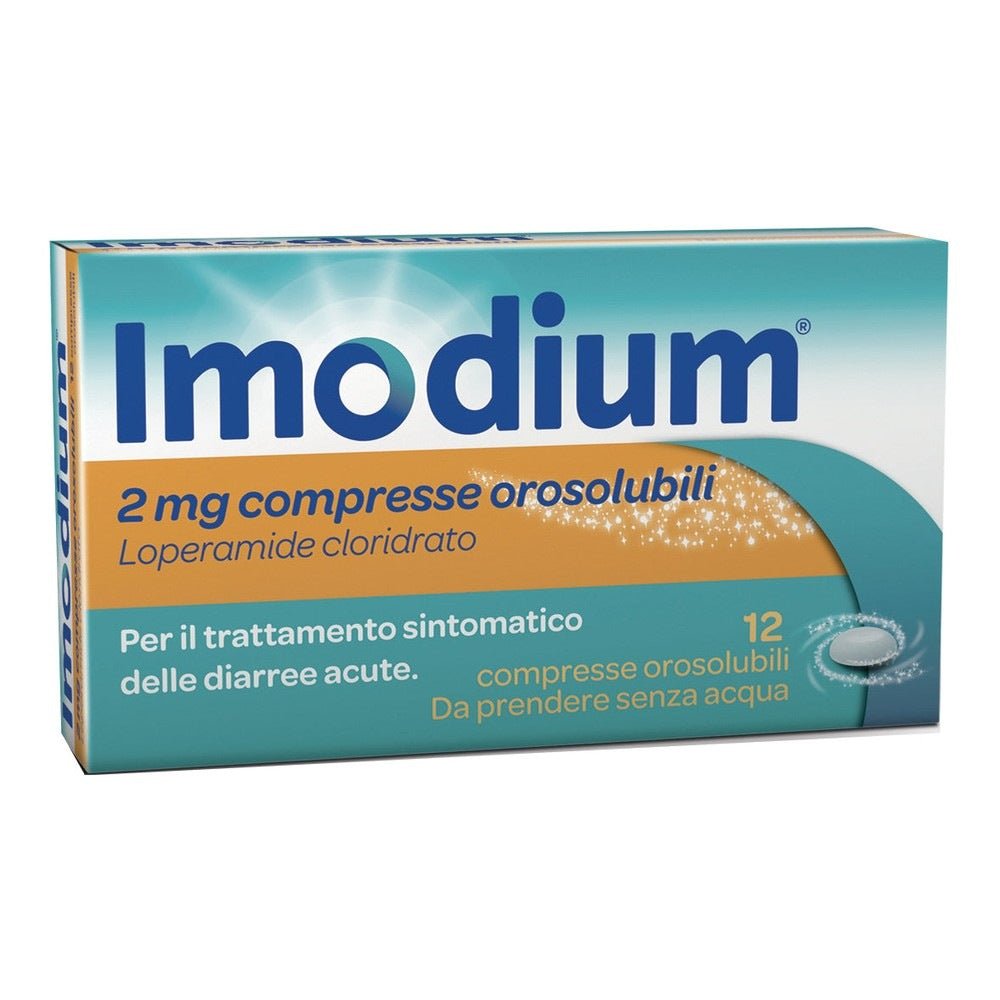
Imodium 2mg 12 orodispersible tablets
Imodium 2mg 12 orodispersible tablets
Couldn't load pickup availability

NET WEIGHT OF THE PRODUCT
NET WEIGHT OF THE PRODUCT
12ct
EAN
EAN
023673092
MINSAN
MINSAN
023673092
In ottemperanza all'articolo 118 “autorizzazione della pubblicità presso il pubblico” del decreto legislativo 24 aprile 2006, numero 219
INDICATIONS
IMODIUM is indicated for the symptomatic treatment of acute diarrhea.
ACTIVE INGREDIENTS
One hard capsule contains: Active ingredient: Loperamide hydrochloride 2 mg. One buccal tablet contains: Active ingredient: Loperamide hydrochloride 2 mg. One soft capsule contains: Active ingredient: Loperamide hydrochloride 2 mg. Excipients with known effects: IMODIUM 2 mg hard capsules: lactose 127 mg. IMODIUM 2 mg buccal tablets: each tablet contains 750 micrograms of aspartame; the mint flavor contains traces of sulphites. IMODIUM 2 mg soft capsules: Each soft capsule contains 115.31 mg of propylene glycol. For the full list of excipients, see section 6.1. For the full list of excipients, see section 6.1.
EXCIPIENTS
IMODIUM 2 mg hard capsules: lactose, corn starch, talc, magnesium stearate. A green-grey hard capsule consists of: erythrosine (E 127); indigo carmine (E 132); yellow iron oxide (E 172); black iron oxide (E 172); titanium dioxide and gelatin. IMODIUM 2 mg buccal tablets: gelatin, mannitol, aspartame, mint flavor, sodium bicarbonate. IMODIUM 2 mg soft capsules: propylene glycol monocaprylate, propylene glycol, distilled water. One capsule consists of: gelatin, glycerol 99%, propylene glycol, FD&C blue n. 1.
CONTRAINDICATIONS AND SIDE EFFECTS
Hypersensitivity to the active substance or to any of the excipients listed in paragraph 6.1; Children under 6 years old; Pregnancy and breastfeeding (see section 4.6 “Pregnancy and breastfeeding”). IMODIUM must not be used as primary therapy: • in acute dysentery characterized by the presence of blood in the stool and high fever; • in patients with acute ulcerative colitis or pseudomembranous colitis due to the use of broad-spectrum antibiotics; • in patients with bacterial enterocolitis caused by invasive organisms including Salmonella, Shigella and Campylobacter. In general, the use of loperamide HCl is contraindicated in all cases where inhibition of peristalsis must be initiated due to the possible risk of significant consequences such as ileus, megacolon and toxic megacolon.
DOSAGE
Dosage Adults The starting dose is 2 hard capsules or 2 soft capsules or 2 buccal tablets (4 mg). Continue treatment with 1 capsule or 1 tablet (2 mg), after each subsequent evacuation of unformed (soft) stools. The maximum daily dose is 8 capsules or tablets per day (16 mg). Special populations Children aged between 6 and 17 years (see section 4.3) The starting dose is 1 hard capsule or 1 soft capsule or 1 buccal tablet (2 mg). Continue treatment with 1 capsule or 1 tablet (2 mg), after each subsequent evacuation of unformed (soft) stools. The maximum daily dose in children must be established on the basis of body weight (3 capsules or tablets/20 kg), but must not exceed a maximum of 8 capsules or tablets per day (16 mg). Available data regarding the use of loperamide HCl in children under 12 years of age are limited (see section 4.8 “Undesirable effects”). Elderly No dose adjustment is necessary in the elderly. Impaired renal function No dose adjustment is necessary in patients with impaired renal function. Impaired liver function Although no data are available in patients with impaired hepatic function, loperamide HCl should be used with caution in these patients due to reduced first pass metabolism (see section 4.4 “Special warnings and precautions for use”). Method of administration IMODIUM 2 mg hard capsules/2 mg soft capsules: take by mouth with a little water. IMODIUM 2 mg buccal tablets: leave the tablet to dissolve on the tongue for a few seconds; the tablet will be dissolved quickly by saliva. It does not require the use of water. Attention : Do not use for more than 2 days. In any case, stop treatment when the stool returns to normal, or if you have not had any bowel movements for 12 hours, or if constipation appears. In episodes of acute diarrhea, loperamide HCl is generally able to stop symptoms within 48 hours. After this period without appreciable results, stop treatment and consult your doctor.
CONSERVATION
Store the medicine at a temperature not exceeding 25°C.
WARNINGS
Treatment of diarrhea with loperamide HCl is symptomatic only. Therefore, where possible, it is also advisable to intervene on the causes of the disorder. In episodes of acute diarrhea, loperamide HCl is generally able to stop the symptoms within 48 hours; after this period without appreciable results, the treatment must be interrupted and the patient must be advised of the need to go to the doctor for a consultation. In patients with diarrhea, especially in children, a significant loss of fluids and electrolytes may occur. In such cases it can be very important to appropriately replenish fluids and electrolytes. Although no pharmacokinetic data are available in patients with hepatic dysfunction, loperamide HCl should be used with caution in these patients due to extensive first pass metabolism. The drug should be used with caution in patients with hepatic impairment as it can lead to relative overdose with CNS toxicity. AIDS patients treated with loperamide HCl for diarrhea should discontinue therapy at the first signs of abdominal distension. In these patients with infectious colitis of bacterial or viral origin, treated with loperamide HCl, isolated cases of intestinal obstruction with an increased risk of toxic megacolon have been found. If constipation or abdominal or ileal distension occurs, stop treatment immediately. Cases of abuse and misuse of loperamide, used as a substitute for opioids, have been reported in individuals with opioid dependence (see section 4.9). Cardiac events including QT and QRS complex prolongation and torsades de pointes have been reported in association with overdose. Some cases have been fatal (see section 4.9). Overdose can manifest the presence of Brugada syndrome. Patients should not exceed the recommended dose and/or prolong the duration of therapy. Pediatric population In children between 6 and 12 years old, IMODIUM must be used exclusively under medical supervision. Available data regarding the use of loperamide HCl in children under 12 years of age are limited (see section 4.8 “Undesirable effects”). Important information about some excipients IMODIUM 2 mg hard capsules contains lactose. Patients suffering from rare hereditary problems of galactose intolerance, total lactase deficiency, or glucose-galactose malabsorption should not take this medicine. IMODIUM 2 mg buccal tablets contains: • traces of sulphites. Sulfites rarely can cause severe hypersensitivity reactions and bronchospasm; • 0.750 mg of aspartame for a single dose which is equivalent to 0.011 mg/kg for a 70 kg adult and 0.038 mg/kg for a 20 kg child. Aspartame is hydrolyzed in the gastrointestinal tract when taken orally. One of the major products of its hydrolysis is phenylalanine. No clinical and non-clinical data are available to evaluate the use of aspartame in infants under 12 weeks of age; • less than 1 mmol (23 mg) of sodium for single dose. It can therefore be considered essentially sodium-free; • 0.00066 mg of benzyl alcohol per single tablet. Benzyl alcohol can cause allergic reactions. It is possible that the accumulation of large quantities of benzyl alcohol could cause metabolic acidosis; use with caution and only if necessary, especially in patients with hepatic or renal insufficiency; • 0.00003 mg of alcohol (ethanol) in each tablet. The amount of ethanol in this medicine is equivalent to less than 0.00000075 ml of beer or 0.0000003 of wine. This medicine contains a quantity of ethanol that does not produce significant effects. IMODIUM 2 mg soft capsules contains: • 115.31 mg of propylene glycol. 115.31 mg of propylene glycol for a single dose, equivalent to 1.65 mg/kg for a 70 kg adult and 5.77 mg/kg for a 20 kg child; • less than 1 mmol (23 mg) of sodium for single dose. It can therefore be considered essentially sodium-free.
INTERACTIONS
Non-clinical data have demonstrated that loperamide is a substrate of P-glycoprotein. Concomitant administration of loperamide (in a single dose of 16 mg) with quinidine or ritonavir (both inhibitors of P-glycoprotein) has shown increases in plasma levels of loperamide by 2 to 3 times. The clinical relevance of this pharmacokinetic interaction with P-glycoprotein inhibitors, when loperamide is administered at recommended doses (2 to a maximum of 16 mg per day) is unknown. Concomitant administration of loperamide (4 mg single dose) and itraconazole, an inhibitor of CYP3A4 and P-glycoprotein, showed a 34-fold increase in plasma levels of loperamide. In the same study, gemfibrozil, a CYP2C8 inhibitor, showed a 2-fold increase in plasma levels of loperamide. The combination of itraconazole and gemfibrozil showed a 4-fold increase in peak plasma loperamide level and a 13-fold increase in total plasma exposure. These increases were not associated with central nervous system (CNS) effects as detected by psychomotor tests (e.g., subjective dizziness and the Digit Symbol Substitution Test). Concomitant administration of loperamide (single dose of 16 mg) and ketoconazole, an inhibitor of CYP3A4 and P-glycoprotein, showed a 5-fold increase in plasma levels of loperamide. This increase was not associated with an increase in pharmacodynamic effects as detected by pupillometry. Concomitant treatment with oral desmopressin resulted in a 3-fold increase in plasma desmopressin concentrations, presumably due to slowed gastrointestinal motility. Concomitant use of cytochrome CYP450 inhibitors is not recommended. Substances that accelerate gastrointestinal transit may decrease the effect of IMODIUM. Drugs with pharmacological properties similar to those of loperamide or drugs that can slow down intestinal peristalsis (e.g. anticholinergics), may increase the effect of IMODIUM.
SIDE EFFECTS
Adults and children aged ≥ 12 years Adverse reactions reported in clinical trials with loperamide HCl The safety of Loperamide HCl was evaluated in 3076 adult and child subjects aged ≥12 years who took part in 31 controlled and uncontrolled clinical trials with loperamide HCl used for the treatment of diarrhoea. Of these, 26 studies dealt with acute diarrhea (N=2755) and 5 with chronic diarrhea (N=321). The most commonly reported adverse drug reactions (ADRs) (i.e., ≥1% incidence) in clinical trials with Loperamide HCl for the treatment of acute diarrhea were as follows: constipation (2.7%), flatulence (1.7%), headache (1.2%), and nausea (1.1%). In clinical trials for the treatment of chronic diarrhea, the most commonly reported ADRs (i.e., ≥1% incidence) were as follows: flatulence (2.8%), constipation (2.2%), nausea (1.2%), and dizziness (1.2%). Table 1 shows ADRs that have been reported with the use of loperamide HCl in clinical trials (in cases of acute or chronic diarrhea) in adults and children aged ≥ 12 years. The frequency of adverse reactions presented in Table 1 and Table 2 is defined using the following convention: Very common (≥1/10); Common (≥1/100 to <1/10); Uncommon (≥1/1,000 to <1/100); Rare (≥1/10,000 to <1/1,000); Very rare (<1/10,000); Not known (frequency cannot be estimated from the available data). Table 1: Adverse reactions reported with the use of loperamide HCl in clinical trials in adults and children aged ≥ 12 years
System Organ Class - Indication: Acute diarrhea (N=2755). Chronic diarrhea (N=321).
Nervous system disorders.
Headache - Indication: Common. Uncommon.
Dizziness - Indication: Uncommon. Common.
Gastrointestinal disorders.
Constipation, Nausea, Flatulence - Indication: Common. Common.
Abdominal pain, Abdominal discomfort, Dry mouth - Indication: Uncommon. Uncommon.
Pain in upper abdomen, Vomiting - Indication: Uncommon.
Dyspepsia - Uncommon.
Abdominal distension - Indication: Rare.
Pathology of the skin and subcutaneous tissue.
Skin rash - Indication: Uncommon.
Adverse reactions reported in post-marketing experience with loperamide HCl Determination of adverse reactions via post-marketing experience for loperamide HCl does not distinguish acute and chronic diarrhea indications or adult and pediatric populations; the data collected therefore represents the combination of the indications (acute and chronic diarrhea) and the populations in question (adults and children). Adverse reactions observed during post-marketing experience for loperamide HCl are listed below in Table 2 according to System Organ Classification, using MedDRA terminology. Table 2: Adverse reactions reported with the use of loperamide HCl in post-marketing experience in adults and children
Immune system disorders - Indication Acute diarrhea + Chronic diarrhea: hypersensitivity reaction, anaphylactic reaction (including anaphylactic shock), anaphylactoid reaction.
Nervous system disorders - Indication Acute diarrhea + Chronic diarrhea: drowsiness, loss of consciousness, stupor, reduced level of consciousness, hypertonia, coordination disorders.
Eye disorders - Indication Acute diarrhea + Chronic diarrhea: miosis.
Gastrointestinal disorders - Indication Acute diarrhea + Chronic diarrhea: ileus (including paralytic ileus), megacolon (including toxic megacolon), glossodynia, acute pancreatitis (frequency not known).
Skin and subcutaneous tissue disorders - Indication Acute diarrhea + Chronic diarrhea: bullous rash (including Stevens-Johnson syndrome, toxic epidermal necrolysis and erythema multiforme), angioedema, urticaria, pruritus.
Renal and urinary disorders - Indication Acute diarrhea + Chronic diarrhea: urinary retention.
Systemic pathologies and conditions relating to the administration site - Indication Acute diarrhea + Chronic diarrhea: fatigue.
Pediatric population The safety of loperamide HCl was evaluated in 607 patients aged 10 days to 13 years, who took part in 13 controlled and uncontrolled clinical trials with loperamide HCl used for the treatment of acute diarrhea. Generally speaking, the ADR profile in this patient population was similar to that observed in clinical studies with loperamide HCl used in adults and children aged 12 years and older. Reporting of suspected adverse reactions Reporting suspected adverse reactions that occur after authorization of the medicine is important, as it allows continuous monitoring of the benefit/risk balance of the medicine. Healthcare professionals are asked to report any suspected adverse reactions via the national reporting system at http://www.agenziafarmaco.gov.it/content/come-segnalare-unasospetti-reazione-avversa.
OVERDOSE
Symptoms In the event of overdose (absolute, due to accidental intake of excessive doses or relative, due to accumulation in the blood of unmetabolised drug, even when administered at the correct doses), including relative overdose due to liver dysfunction, CNS depression (drowsiness, uncoordinated movements, drowsiness, miosis, muscular hypertonia, respiratory depression), intestinal obstruction and urinary retention may occur. Cardiac events such as prolongation of the QT interval and QRS complex, torsade de pointes, other serious ventricular arrhythmias, cardiac arrest and syncope have been observed in patients who have ingested excessive doses of loperamide (see section 4.4). Fatal cases have also been reported. Overdose can manifest the presence of Brugada syndrome. Children are more sensitive than adults to the effects of an overdose of IMODIUM. It is therefore recommended to keep the product out of their reach because accidental ingestion, especially in children under 4 years of age, can cause constipation and central nervous system depression with drowsiness and slowed breathing. Treatment In case of overdose, ECG monitoring for QT interval prolongation should be initiated. Urgent measures: if symptoms of overdose appear, naloxone can be used as an antidote; administer naloxone and possibly repeat the treatment after 1-3 hours as loperamide has a longer duration of action than that of the antidote. The patient must be monitored for at least 48 hours to detect any worsening of central nervous system depression.
PREGNANCY AND BREASTFEEDING
The administration of IMODIUM is contraindicated during pregnancy and breastfeeding. Pregnant or breastfeeding women should therefore be advised of the need to consult their doctor for the most appropriate treatment.
EFFECTS ON DRIVING ABILITY
Loperamide HCl may cause tiredness, dizziness, or lightheadedness. It is therefore preferable to use caution when driving motor vehicles or operating dangerous machinery.
OUR PRODUCTS FOR THIS SEASON
-
Curial βeta Dry eye supplement 30 capsules Dr.Tili
Vendor:TilpharmaRegular price €22,50Regular priceUnit price per€22,50Sale price €22,50 -
T - Relaxfast Sleep Supplement 60 Capsules Dr.Tili
Vendor:TilpharmaRegular price €24,50Regular priceUnit price per€24,50Sale price €24,50 -
Face Serum C5 Vitamin C 30ml Dr.Tili Skinlab
Vendor:TilabRegular price €62,50Regular priceUnit price per€62,50Sale price €62,50 -
Dr.Tili Skinlab E15 Vitamin E Face Serum 30ml
Vendor:TilabRegular price €32,50Regular priceUnit price per€32,50Sale price €32,50 -
Vit+ Face Vitamin Cream 50ml Dr.Tili Skinlab
Vendor:TilabRegular price €34,00Regular priceUnit price per€34,00Sale price €34,00 -
Anti-aging Facial Treatment Hyaluronic Acid IAL B3 30ml Dr.Tili Skinlab
Vendor:TilabRegular price €46,00Regular priceUnit price per€46,00Sale price €46,00 -
Body Milk Hydra Milk 200Ml. Dr.Tili Skinlab
Vendor:TilabRegular price €16,90Regular priceUnit price per€16,90Sale price €16,90 -
Facial Cleansing Milk 150ml Dr.Tili Skinlab
Vendor:TilabRegular price €18,90Regular priceUnit price per€18,90Sale price €18,90 -
Soothing Facial Toner 125ml Dr.Tili Skinlab
Vendor:TilabRegular price €14,50Regular priceUnit price per€14,50Sale price €14,50 -
Soothing Face Cream 50ml Dr.Tili Skinlab
Vendor:TilabRegular price €19,50Regular priceUnit price per€19,50Sale price €19,50

















-

ASSISTANCE - TELEPHONE ORDERS
-

SHIPPING
Shipping to Italy 24/48H
Delivery also on Saturday and Sunday
Free over €49.90
Shipping to Europe 24/72H
Free over €80 -

SAFETY
The security of your data is important to us!
We strictly comply with the European GDPR regarding
Privacy and processing of personal data
The payments you make on our site are 100% safe and guaranteed -

RETURNS
Fast returns via DIY portal and 14 days to change your mind.
Immediate and free replacements for incorrect or non-compliant products delivered.


