

Opella Healthcare
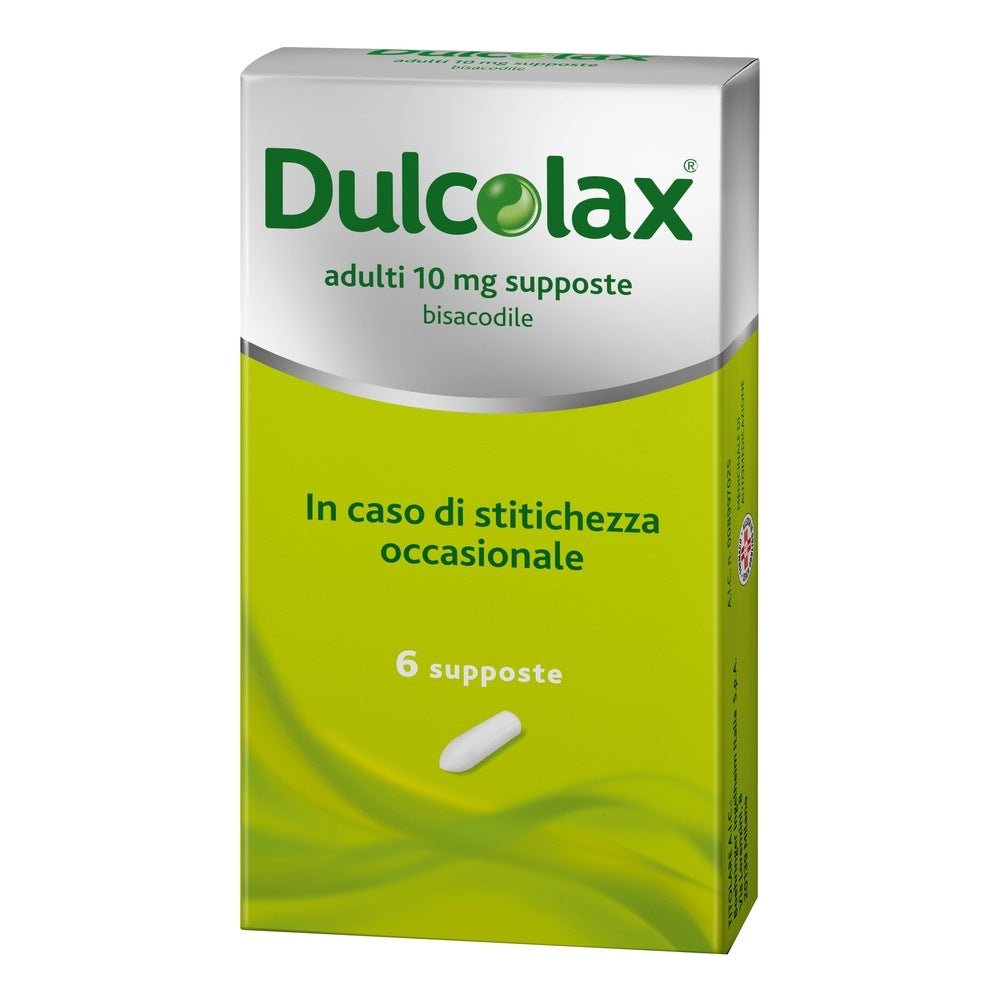
Dulcolax adults 10mg 6 suppositories
Dulcolax adults 10mg 6 suppositories

Couldn't load pickup availability

NET WEIGHT OF THE PRODUCT
NET WEIGHT OF THE PRODUCT
6ct
EAN
EAN
008997025
MINSAN
MINSAN
008997025
In ottemperanza all'articolo 118 “autorizzazione della pubblicità presso il pubblico” del decreto legislativo 24 aprile 2006, numero 219
INDICATIONS
Short-term treatment of occasional constipation.
ACTIVE INGREDIENTS
COATED TABLETS One coated tablet contains: bisacodyl 5 mg. Excipients with known effects: lactose, sucrose, castor oil. ADULTS SUPPOSITORIES One suppository contains: bisacodyl 10 mg. CHILDREN SUPPOSITORIES One suppository contains: bisacodyl 5 mg. For the full list of excipients, see section 6.1.
EXCIPIENTS
COATED TABLETS Lactose monohydrate, corn starch, modified starch, glycerol, magnesium stearate, sucrose, talc, gum arabic, titanium dioxide (E171), methacrylic acid/methyl methacrylate copolymer (1:1), methacrylic acid/methyl methacrylate copolymer (1:2), castor oil, macrogol 6000, iron oxide (E172), white wax, carnauba wax, shellac. SUPPOSITORIES Triglycerides of saturated fatty acids.
CONTRAINDICATIONS AND SIDE EFFECTS
Hypersensitivity to the active substance or to any of the excipients. Dulcolax is also contraindicated in patients with paralytic ileus, acute abdominal conditions, such as appendicitis, and severe abdominal pain associated with nausea and vomiting which may be signs indicative of serious pathological conditions, in intestinal obstruction or stenosis, acute inflammation of the gastrointestinal tract, rectal bleeding of unknown origin, severe state of dehydration. Pregnancy and breastfeeding (see section 4.6). The use of Dulcolax is contraindicated in cases of rare hereditary conditions that may be incompatible with the intake of one of the excipients (see section 4.4 "special warnings and precautions for use"). Dulcolax is contraindicated in children under 2 years of age. Suppositories are contraindicated in cases of anal fissures and ulcers (perianal pain and bleeding may occur).
DOSAGE
COATED TABLETS - Adults: 1-2 coated tablets per day. Pediatric population - Children over 10 years: 1-2 coated tablets per day. - Children aged between 2 and 10 years: 1 coated tablet per day. It is advisable to start with the minimum expected dose. The dose can then be increased, up to the maximum recommended dose, for regular stool evacuation. The maximum daily dose must never be exceeded. Instructions for use Take the coated tablets preferably in the evening to determine an evacuation the following morning (after approximately 10 hours). When administered in the morning, on an empty stomach, the effect is obtained after approximately five hours. The coated tablets should not be administered together with products that reduce the acidity of the upper gastrointestinal tract, such as milk, antacids (e.g. bicarbonate) or proton pump inhibitors. The coated tablets should be swallowed whole. Swallow together with an adequate quantity of water (a large glass). A diet rich in liquids favors the effect of the medicine. SUPPOSITORIES - Adults: 1 adult suppository (10 mg) per day. Pediatric population - Children over 10 years: 1 adult suppository (10 mg) per day. - Children aged between 2 and 10 years: 1 children's suppository (5 mg) per day. The maximum daily dose must never be exceeded. Children aged 10 years and younger with chronic or persistent constipation should take Dulcolax under their doctor's supervision. Dulcolax must not be administered to children under two years of age. Instructions for use The effect of suppositories usually occurs in about 20 minutes (range: 10 - 30 minutes). Do not exceed the recommended doses. Laxatives should be used as infrequently as possible and for no longer than seven days. Use for longer periods of time requires a doctor's prescription after adequate evaluation of the individual case.
CONSERVATION
Coated tablets: this medicine does not require any special storage conditions. Suppositories: Do not store above 30°C.
WARNINGS
Warnings Like all laxatives, Dulcolax should not be taken continuously every day or for long periods of time without investigating the cause of the constipation. In case of diabetes mellitus, hypertension or heart disease, use only after consulting your doctor. Abuse of laxatives (frequent or prolonged use or with excessive doses) can cause persistent diarrhea with consequent loss of water, mineral salts (especially potassium) and other essential nutritional factors. In more severe cases, the onset of dehydration or hypokalemia is possible which can cause cardiac or neuromuscular dysfunction, especially in case of simultaneous treatment with cardiac glycosides, diuretics or corticosteroids. Intestinal loss of fluids can cause dehydration. Symptoms may be thirst and oliguria. In patients for whom dehydration may be dangerous (patients with renal insufficiency, elderly patients), treatment with Dulcolax should be stopped and restarted only under medical supervision. Hematochezia (blood in the stool) may occur in patients, which is usually mild and goes away on its own. The abuse of laxatives, especially contact laxatives (stimulant laxatives), can cause dependence (and, therefore, possible need to progressively increase the dosage), chronic constipation and loss of normal intestinal functions (intestinal atony). Cases of dizziness and/or syncope have been reported after taking Dulcolax. The data relating to these cases suggest that the events, rather than a phenomenon related to the intake of Dulcolax, could be interpreted as a manifestation of "defecation syncope" (attributable to the effort of the act of defecation), or as a vasovagal response to abdominal pain related to the constipation itself. The use of suppositories can lead to painful sensations and local irritation, in particular, in patients with fissures and ulcerative proctitis (see section 4.3 “contraindications”). Stimulant laxatives including Dulcolax do not contribute to weight loss (see section 5.1 “Pharmacodynamic properties”). Important information about some excipients: Dulcolax tablets contain 33.2 mg of lactose equal to 66.42 mg in case of taking the maximum daily dose, for the treatment of constipation in adults and adolescents over 10 years of age. Patients suffering from rare hereditary problems of galactose intolerance, Lapp lactase deficiency or glucose-galactose malabsorption should not take this medicine tablets. Dulcolax tablets contain 23.4 mg of sucrose equal to 46.8 mg when taking the maximum daily dose for the treatment of constipation in adults and adolescents over 10 years of age. Patients suffering from rare hereditary problems of fructose intolerance, glucose-galactose malabsorption, or sucrase-isomaltase deficiency should not take this medicine tablets. Dulcolax tablets may cause gastric upset and diarrhoea. Precautions for use In children aged between 2 years and 10 years the medicine can only be used after consulting the doctor (see section 4.3). Like all laxatives, it should not be taken daily or for prolonged periods without first evaluating the cause of the constipation. The treatment of chronic or recurrent constipation always requires the intervention of a doctor for diagnosis, prescription of drugs and monitoring during the course of therapy. Consult your doctor when the need for the laxative derives from a sudden change in previous intestinal habits (frequency and characteristics of evacuations) that lasts for more than two weeks or when the use of the laxative fails to produce effects. It is also advisable for elderly people or those in poor health to consult their doctor before using the medicine.
INTERACTIONS
Concomitant administration of diuretics or adrenocorticosteroids and excessive doses of Dulcolax may lead to an increased risk of electrolyte imbalance. This imbalance, in turn, can lead to increased sensitivity to cardiac glycosides. Laxatives can reduce the residence time in the intestine, and therefore the absorption, of other drugs administered simultaneously orally. Therefore, avoid ingesting laxatives and other drugs at the same time: after taking a medicine, leave an interval of at least two hours before taking the laxative. Milk or antacids can change the effect of the medicine; leave an interval of at least one hour before taking the laxative. Concomitant use of other laxatives may potentiate the gastrointestinal side effects of Dulcolax.
SIDE EFFECTS
The most commonly reported side effects during treatment with Dulcolax are abdominal pain and diarrhea. Immune system disorders: anaphylactic reactions, angioneurotic edema as well as other hypersensitivity reactions. Metabolism and nutrition disorders: dehydration. Nervous system disorders: dizziness, syncope. The phenomena of dizziness and syncope that occur after taking bisacodyl appear to be attributable to a vasovagal response (resulting, for example, from abdominal pain, or the evacuation of feces). Gastrointestinal disorders: abdominal cramps, abdominal pain, diarrhea, nausea, hematochezia (blood in stool), vomiting, abdominal discomfort, anorectal discomfort, colitis including ischemic colitis. Reporting of suspected adverse reactions Reporting suspected adverse reactions that occur after authorization of the medicine is important, as it allows continuous monitoring of the benefit/risk balance of the medicine. Healthcare professionals are asked to report any suspected adverse reactions via the national reporting system at: http://www.agenziafarmaco.gov.it/content/come-segnalare-una-sospetta-reazione-avversa.
OVERDOSE
Symptoms Excessive doses can cause abdominal pain and diarrhea, and significant losses of potassium and other electrolytes. Chronic overdose of Dulcolax, as with other laxatives, can cause chronic diarrhea, abdominal pain, hypokalemia, secondary hyperaldosteronism and kidney stones. Renal tubular injury, metabolic alkalosis, and muscle weakness secondary to hypokalemia have also been described in association with chronic laxative abuse. Also see what is reported in the paragraph “Special warnings and precautions for use” regarding the abuse of laxatives. Treatment If action is taken within a short time of ingesting the oral form of Dulcolax, absorption can be reduced or avoided by inducing vomiting or gastric lavage. Fluid and electrolyte losses must be replaced. This is especially important in elderly and young patients. The administration of spasmolytics may be useful.
PREGNANCY AND BREASTFEEDING
Pregnancy There are no adequate and well-controlled studies on the use of the medicine during pregnancy. Therefore, although unwanted or toxic effects have never been reported during pregnancy, like all medicines, Dulcolax must be used only if necessary, under the direct supervision of a doctor, after evaluating the expected benefit for the mother in relation to the possible risk for the fetus. Fertility No studies have been conducted to investigate the effects on human fertility. Breastfeeding Clinical data demonstrate that neither the active form of bisacodyl BHPM, bis-(p-hydroxyphenyl)-pyridyl-2-methane (BHPM), nor its glucuronic derivatives are excreted in breast milk, however the medicine should only be used if necessary, under direct medical supervision, after evaluating the expected benefit for the mother in relation to the possible risk for the infant.
EFFECTS ON DRIVING ABILITY
No studies on the effects on the ability to drive and use machines have been performed. However, patients should be informed that due to vasovagal response (e.g., abdominal spasm), dizziness and/or syncope may occur. If patients experience abdominal spasm they should avoid potentially dangerous activities such as driving or using machinery.
OUR PRODUCTS FOR THIS SEASON
-
Curial βeta Dry eye supplement 30 capsules Dr.Tili
Vendor:TilpharmaRegular price €22,50Regular priceUnit price per€22,50Sale price €22,50 -
T - Relaxfast Sleep Supplement 60 Capsules Dr.Tili
Vendor:TilpharmaRegular price €24,50Regular priceUnit price per€24,50Sale price €24,50 -
Face Serum C5 Vitamin C 30ml Dr.Tili Skinlab
Vendor:TilabRegular price €62,50Regular priceUnit price per€62,50Sale price €62,50 -
Dr.Tili Skinlab E15 Vitamin E Face Serum 30ml
Vendor:TilabRegular price €32,50Regular priceUnit price per€32,50Sale price €32,50 -
Vit+ Face Vitamin Cream 50ml Dr.Tili Skinlab
Vendor:TilabRegular price €34,00Regular priceUnit price per€34,00Sale price €34,00 -
Anti-aging Facial Treatment Hyaluronic Acid IAL B3 30ml Dr.Tili Skinlab
Vendor:TilabRegular price €46,00Regular priceUnit price per€46,00Sale price €46,00 -
Body Milk Hydra Milk 200Ml. Dr.Tili Skinlab
Vendor:TilabRegular price €16,90Regular priceUnit price per€16,90Sale price €16,90 -
Facial Cleansing Milk 150ml Dr.Tili Skinlab
Vendor:TilabRegular price €18,90Regular priceUnit price per€18,90Sale price €18,90 -
Soothing Facial Toner 125ml Dr.Tili Skinlab
Vendor:TilabRegular price €14,50Regular priceUnit price per€14,50Sale price €14,50 -
Soothing Face Cream 50ml Dr.Tili Skinlab
Vendor:TilabRegular price €19,50Regular priceUnit price per€19,50Sale price €19,50

















-

ASSISTANCE - TELEPHONE ORDERS
-

SHIPPING
Shipping to Italy 24/48H
Delivery also on Saturday and Sunday
Free over €49.90
Shipping to Europe 24/72H
Free over €80 -

SAFETY
The security of your data is important to us!
We strictly comply with the European GDPR regarding
Privacy and processing of personal data
The payments you make on our site are 100% safe and guaranteed -

RETURNS
Fast returns via DIY portal and 14 days to change your mind.
Immediate and free replacements for incorrect or non-compliant products delivered.


