

Bruschettini
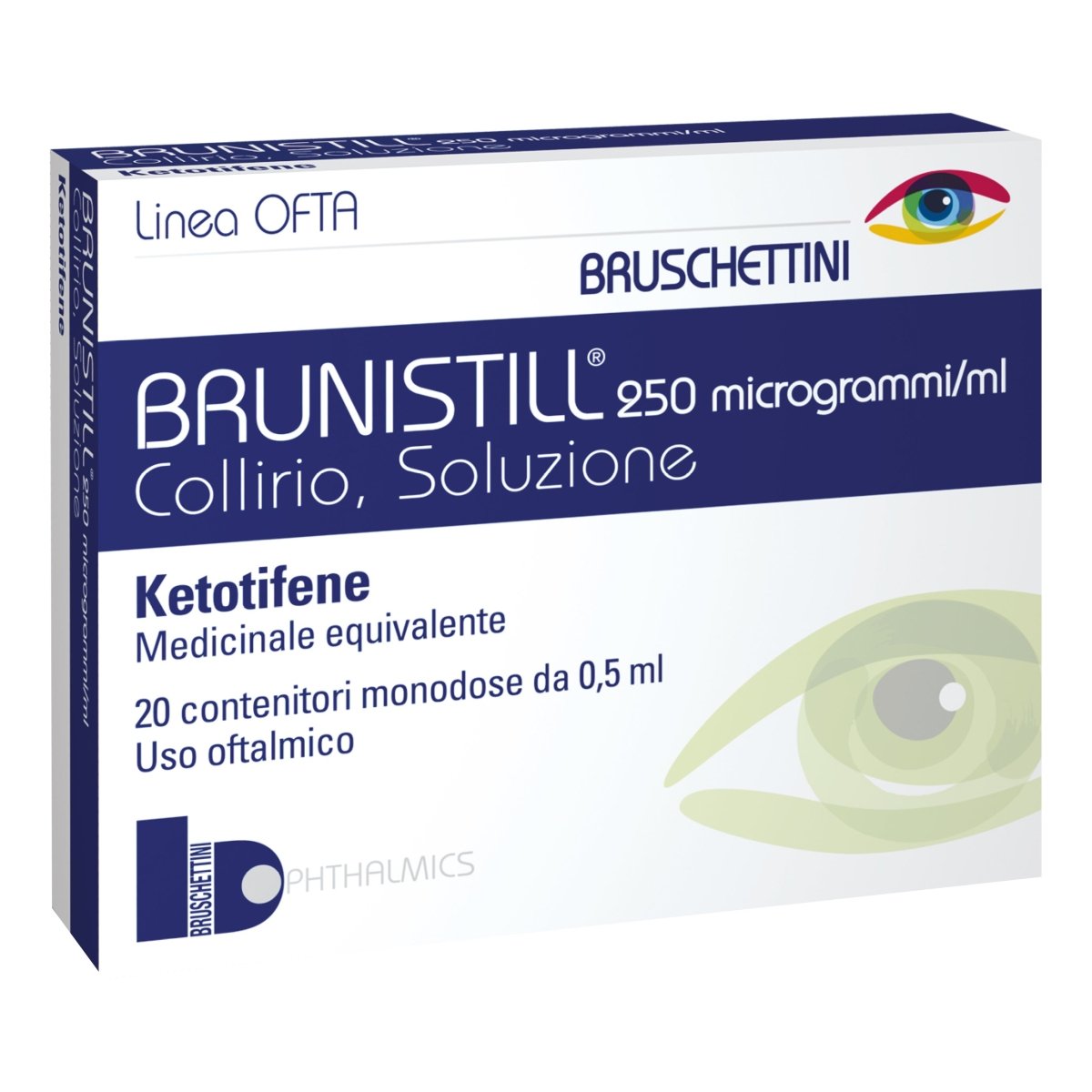
Brunistill 0.025% 20×single-dose eye drops solution
Brunistill 0.025% 20×single-dose eye drops solution
Couldn't load pickup availability

NET WEIGHT OF THE PRODUCT
NET WEIGHT OF THE PRODUCT
10ml
EAN
EAN
037448026
MINSAN
MINSAN
037448026
In ottemperanza all'articolo 118 “autorizzazione della pubblicità presso il pubblico” del decreto legislativo 24 aprile 2006, numero 219
INDICATIONS
BRUNISTILL is indicated in the symptomatic treatment of seasonal allergic conjunctivitis.
ACTIVE INGREDIENTS
A single-dose container of 0.5 ml of solution contains: Active ingredient: Ketotifen: 125 micrograms (as hydrogen fumarate), equal to 250 micrograms/ml. For the full list of excipients, see section 6.1.
EXCIPIENTS
Glycerol (E422), Sodium Hydroxide, Purified water.
CONTRAINDICATIONS AND SIDE EFFECTS
Hypersensitivity to the active substance ketotifen or to any of the excipients listed in section 6.1.
DOSAGE
Dosage Adults, elderly and children (over 3 years): a drop of eye drops in the conjunctival sac twice a day. The contents of a single-dose container are sufficient for administration in both eyes. Method of administration Contents and container remain sterile until the original closure is opened. To avoid the risk of contamination, do not touch any surface with the tip of the container.
CONSERVATION
Store at a temperature not exceeding 25°C.
WARNINGS
No special precautions.
INTERACTIONS
If you are using other medicines for ocular use, you should leave at least 5 minutes between one application and another. Oral administration of ketotifen may potentiate the effects of CNS depressants, antihistamines and alcohol. Although these phenomena have not been observed with BRUNISTILL, the possibility of such effects cannot be excluded.
SIDE EFFECTS
Adverse drug reactions from clinical trials (Table 1) are listed according to MedDRA classification. Within each systemic organ class, adverse drug reactions are classified by frequency with the most frequent first. Within each frequency grouping, reactions are presented in order of decreasing severity. The following side effects have been reported at the recommended dose: The frequency listed below is defined using the following convention: very common (≥ 1/10), common (≥ 1/100 to <1/10); uncommon (from ≥ 1/1000 <1/100); rare (from ≥ 1/10,000 to < 1/1,000); very rare (<1/10,000), not known (frequency cannot be estimated from the available data).
Eye disorders: - Adverse events: eye irritation, eye pain, punctate keratitis, punctate epithelial erosion. Frequency: Common.
Eye disorders: - Adverse events: blurred vision (during instillation), dry eye, eyelid disorders, conjunctivitis, photophobia, conjunctival hemorrhages. Frequency: Uncommon.
Nervous system disorders: - Adverse events: headache. Frequency: Uncommon.
Systemic disorders and conditions relating to the administration site - Adverse events: drowsiness. Frequency: Uncommon.
Skin and subcutaneous tissue disorders: - Adverse events: rash, eczema, urticaria. Frequency: Uncommon.
Gastrointestinal disorders: - Adverse events: dry mouth. Frequency: Uncommon.
Immune system disorders: - Adverse events: hypersensitivity. Frequency: Uncommon.
Adverse drug reactions from post-marketing experience (frequency not known). The following post-marketing events were also observed: hypersensitivity reactions including local allergic reactions (mostly contact dermatitis, eye swelling, eyelid pruritus and edema), systemic allergic reactions including facial swelling/edema (in some cases associated with contact dermatitis) and exacerbation of pre-existing allergic conditions such as asthma and eczema. Reporting of suspected adverse reactions Reporting suspected adverse reactions that occur after authorization of the medicinal product is important, as it allows continuous monitoring of the benefit/risk balance of the medicinal product. Healthcare professionals are asked to report any suspected adverse reactions via the national reporting system at www.agenziafarmaco.gov.it/it/responsabili".
OVERDOSE
No cases of overdose have been found. Oral intake of the contents of a single-dose container would be equivalent to 0.1 mg of Ketotifen, equal to 5% of a recommended daily oral dose for a 3-year-old child. Clinical results indicated no serious signs or symptoms following ingestion of a dose of up to 20 mg of ketotifen.
PREGNANCY AND BREASTFEEDING
Pregnancy No clinical data are available on the use of BRUNISTILL during pregnancy. Animal studies with toxic oral doses have shown an increase in pre- and postnatal mortality, but have not shown teratogenic effects. Systemic levels of ketotifen after ophthalmic application are much lower than those achieved after oral administration. However, caution should be used when prescribing the medicine to pregnant women. Breastfeeding Although data from consecutive animal studies following oral administration demonstrate the excretion of the active ingredient in breast milk, it is unlikely that topical administration in women can produce detectable quantities of active ingredient in breast milk. Mothers who use BRUNISTILL eye drops can therefore breastfeed. Fertility No data are available on the effect of ketotifen hydrogphen fumarate on fertility in humans.
EFFECTS ON DRIVING ABILITY
If a patient has blurred vision or drowsiness, he or she should refrain from driving vehicles and using machinery.
OUR PRODUCTS FOR THIS SEASON
-
Curial βeta Dry eye supplement 30 capsules Dr.Tili
Vendor:TilpharmaRegular price €22,50Regular priceUnit price per€22,50Sale price €22,50 -
T - Relaxfast Sleep Supplement 60 Capsules Dr.Tili
Vendor:TilpharmaRegular price €24,50Regular priceUnit price per€24,50Sale price €24,50 -
Face Serum C5 Vitamin C 30ml Dr.Tili Skinlab
Vendor:TilabRegular price €62,50Regular priceUnit price per€62,50Sale price €62,50 -
Dr.Tili Skinlab E15 Vitamin E Face Serum 30ml
Vendor:TilabRegular price €32,50Regular priceUnit price per€32,50Sale price €32,50 -
Vit+ Face Vitamin Cream 50ml Dr.Tili Skinlab
Vendor:TilabRegular price €34,00Regular priceUnit price per€34,00Sale price €34,00 -
Anti-aging Facial Treatment Hyaluronic Acid IAL B3 30ml Dr.Tili Skinlab
Vendor:TilabRegular price €46,00Regular priceUnit price per€46,00Sale price €46,00 -
Body Milk Hydra Milk 200Ml. Dr.Tili Skinlab
Vendor:TilabRegular price €16,90Regular priceUnit price per€16,90Sale price €16,90 -
Facial Cleansing Milk 150ml Dr.Tili Skinlab
Vendor:TilabRegular price €18,90Regular priceUnit price per€18,90Sale price €18,90 -
Soothing Facial Toner 125ml Dr.Tili Skinlab
Vendor:TilabRegular price €14,50Regular priceUnit price per€14,50Sale price €14,50 -
Soothing Face Cream 50ml Dr.Tili Skinlab
Vendor:TilabRegular price €19,50Regular priceUnit price per€19,50Sale price €19,50
















-

ASSISTANCE - TELEPHONE ORDERS
-

SHIPPING
Shipping to Italy 24/48H
Delivery also on Saturday and Sunday
Free over €49.90
Shipping to Europe 24/72H
Free over €80 -

SAFETY
The security of your data is important to us!
We strictly comply with the European GDPR regarding
Privacy and processing of personal data
The payments you make on our site are 100% safe and guaranteed -

RETURNS
Fast returns via DIY portal and 14 days to change your mind.
Immediate and free replacements for incorrect or non-compliant products delivered.


