

Procter & Gamble
Vicks Cough Sedative 1, 33 mg/ml 180 ml syrup
Vicks Cough Sedative 1, 33 mg/ml 180 ml syrup
Vicks Cough Sedative 1.33 mg/ml syrup is a dry cough sedative based on dextromethorphan hydrobromide , suitable for adults and children over 12 years of age. It quickly soothes tickling in the throat and coughing fits , promoting rest, thanks also to the pleasant-tasting honey content. 180 ml bottle with measuring cup for precise dosing . Use for short periods as directed.
Couldn't load pickup availability

NET WEIGHT OF THE PRODUCT
NET WEIGHT OF THE PRODUCT
EAN
EAN
028688024
MINSAN
MINSAN
028688024
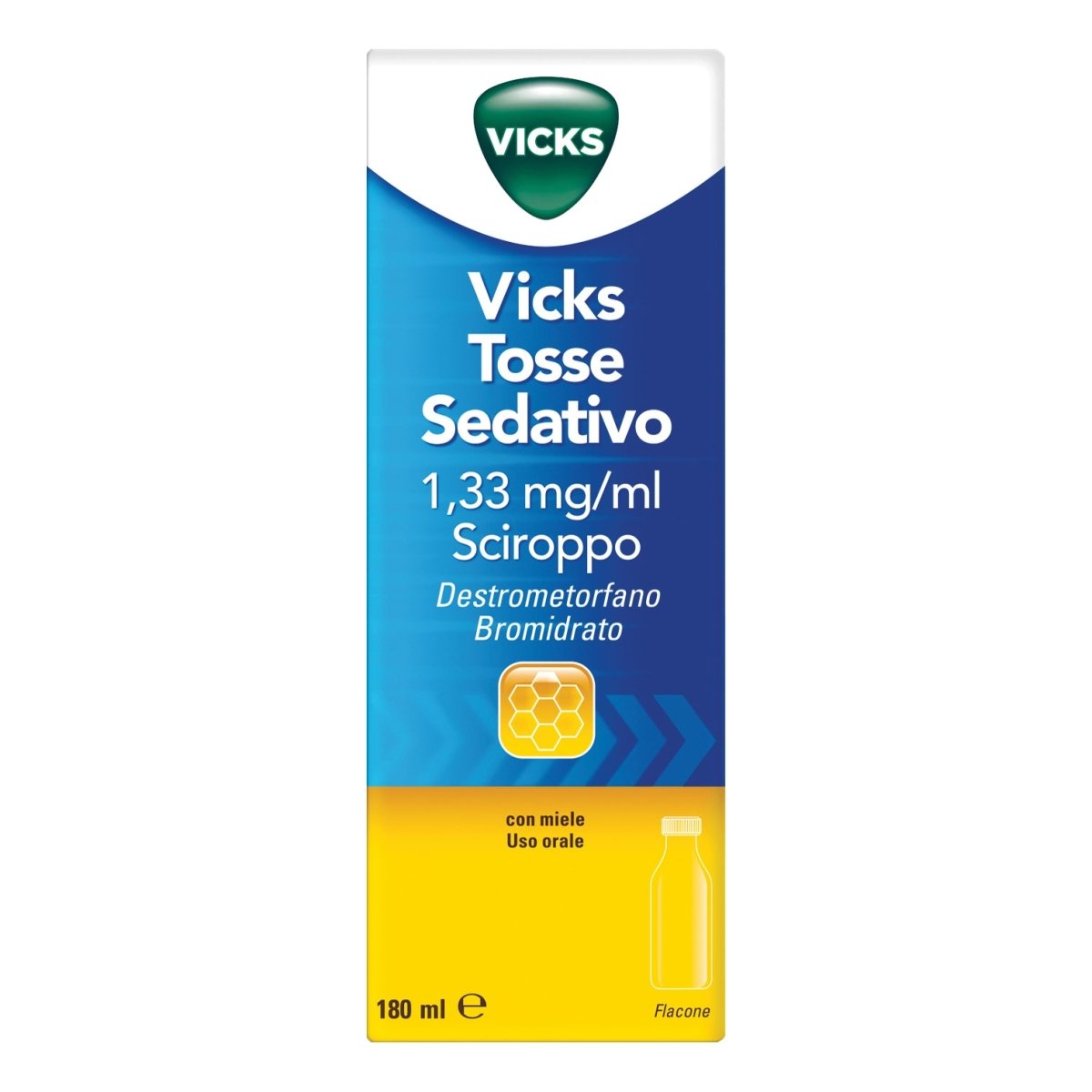
Vicks Cough Sedative 1.33 mg/ml 180 ml syrup is a sedative syrup specifically formulated for the treatment of dry cough and annoying tickling in the throat . Thanks to its active ingredient, dextromethorphan hydrobromide , it acts effectively as a cough sedative , helping to calm coughing fits and promote the well-being of the respiratory tract . Its formulation also contains honey , which helps to make the taste more pleasant and to soothe an irritated throat.
The product is packaged in a practical 180 ml glass bottle , equipped with a child-proof closure and measuring cup for safe and precise use. Vicks Cough Sedative is an over-the-counter oral medicine , indicated for adults and adolescents over 12 years of age, ideal for those looking for a quick and effective remedy against dry cough that disturbs nighttime rest or daily activities.
The presence of dextromethorphan hydrobromide guarantees a targeted action in calming the cough without interfering with normal respiratory functions. The formula is enriched with selected ingredients to offer rapid and long-lasting relief, making Vicks Cough Sedative a reliable choice for those who want a dry cough syrup of proven effectiveness.
ACTIVE INGREDIENTS
Active ingredients contained in Vicks Cough Sedative 1.33 mg/ml 180 ml syrup - What is the active ingredient of Vicks Cough Sedative 1.33 mg/ml 180 ml syrup?
100 ml of syrup contain : Active ingredient : dextromethorphan hydrobromide 0.133% w/V (0.133 g). Excipients with known effect: • Sucrose: 5.55 g/15 ml • Sodium: 28.2 mg/15 ml • Ethanol 96%: 0.592 g/15 ml • Invert sugar (honey): 0.570 g/15 ml • Propylene glycol: 0.850 g/15 ml • Sodium benzoate 15 mg/15 ml • Phenylalanine (honey) For the full list of excipients, see section 6.1.EXCIPIENTS
Composition of Vicks Cough Sedative 1.33 mg/ml 180 ml syrup - What does Vicks Cough Sedative 1.33 mg/ml 180 ml syrup contain?
Sucrose; sodium saccharin; propylene glycol; ethanol 96 percent; sodium carmellose; sodium citrate; citric acid anhydrous; honey flavor (containing honey); verbena flavor; sodium benzoate; polyethylene oxide; mentoxypropanediol; polyoxystearate 40; purified water.DIRECTIONS
Therapeutic indications Vicks Cough Sedative 1.33 mg/ml 180 ml syrup - Why is Vicks Cough Sedative 1.33 mg/ml 180 ml syrup used? What is it used for?
Cough suppressant.CONTRAINDICATIONS AND SIDE EFFECTS
Contraindications Vicks Cough Sedative 1.33 mg/ml 180 ml syrup - When should Vicks Cough Sedative 1.33 mg/ml 180 ml syrup not be used?
Hypersensitivity to the active substance, to structurally similar compounds, or to any of the excipients listed in paragraph 6.1. Do not use concurrently and within two weeks of therapy with MAO inhibitor antidepressant drugs (see paragraph 4.5). Bronchial asthma, COPD (chronic obstructive pulmonary disease), pneumonia, breathing difficulties, respiratory depression, cardiovascular disease, hypertension, hyperthyroidism, diabetes, glaucoma, prostatic hypertrophy, gastrointestinal and urogenital tract stenosis, epilepsy, severe liver disease. Do not administer to children under 12 years of age. Pregnancy, especially in the first trimester, breastfeeding (see paragraph 4.6).DOSAGE
Quantity and method of taking Vicks Cough Sedative 1.33 mg/ml 180 ml syrup - How to take Vicks Cough Sedative 1.33 mg/ml 180 ml syrup?
Adults and adolescents over 12 years: 15 ml (equivalent to 3 teaspoons). These doses can be repeated every 6 hours, up to 4 times a day. Do not exceed the recommended doses. Children under 12 years: dextromethorphan should not be used.CONSERVATION
Storage Vicks Cough Sedative 1.33 mg/ml 180 ml syrup - How do you store Vicks Cough Sedative 1.33 mg/ml 180 ml syrup?
Store at a temperature not exceeding 25°C.WARNINGS
Warnings Vicks Cough Sedative 1.33 mg/ml 180 ml syrup - About Vicks Cough Sedative 1.33 mg/ml 180 ml syrup it is important to know that:
Treatment with dextromethorphan should not be continued beyond 5-7 days. If there is no therapeutic response within a few days, the physician should reassess the situation. Dextromethorphan may be habit-forming. Patients may develop tolerance to the drug, as well as mental and physical dependence, following prolonged use (see section 4.8). Cases of abuse and dependence on dextromethorphan have been reported. Caution is advised particularly in adolescents and young adults, as well as in patients with a history of drug or psychoactive substance abuse. Risks from concomitant use of sedative medicines such as benzodiazepines or related drugs Concomitant use of Vicks Cough Sedative and sedative medicines such as benzodiazepines, or related drugs, may result in sedation, respiratory depression, coma and death. Because of these risks, concomitant prescribing with sedative medicines should be reserved for patients for whom alternative treatment options are not available. If Vicks Cough is prescribed concomitantly with sedative medicinal products, the lowest effective dose should be used and the duration of treatment should be as short as possible. Patients should be carefully monitored for signs and symptoms of respiratory depression and sedation. In this respect, it is strongly recommended to inform patients and their caregivers in order to make them aware of these symptoms (see section 4.5). Dextromethorphan is metabolised by the hepatic cytochrome P450 2D6. The activity of this enzyme is genetically determined. Approximately 10% of the population are slow metabolisers of CYP2D6. Exaggerated and/or prolonged effects of dextromethorphan may occur in poor metabolisers and patients with concomitant use of CYP2D6 inhibitors. Caution should therefore be exercised in patients who are poor metabolisers of CYP2D6 or who use CYP2D6 inhibitors (see also section 4.5). Serotonin syndrome Serotonergic effects, including the development of a potentially life-threatening serotonin syndrome, have been reported for dextromethorphan with concomitant administration of serotonergic agents, such as selective serotonin reuptake inhibitors (SSRIs), drugs which impair metabolism of serotonin (including monoamine oxidase inhibitors [MAOIs]), and CYP2D6 inhibitors. Serotonin syndrome may include mental-status changes, autonomic instability, neuromuscular abnormalities, and/or gastrointestinal symptoms. If serotonin syndrome is suspected, treatment with Vicks Cough Sedative should be discontinued. A chronic cough may be an early symptom of asthma and therefore dextromethorphan is not indicated for the suppression of chronic or persistent cough (e.g. due to smoking, emphysema, asthma, etc.). Dextromethorphan should be administered with particular caution and only on medical advice if the cough is accompanied by other symptoms such as: fever, rash, headache, nausea and vomiting. In case of irritating cough with considerable mucus production, treatment with dextromethorphan should be administered with particular caution and only on medical advice after a careful risk-benefit assessment. Administer with caution in subjects with impaired liver or kidney function, especially in patients with severe impairment. Information on excipients with known effect: - Sucrose and invert sugar (honey): Patients with rare hereditary problems of fructose intolerance, glucose-galactose malabsorption or sucrase-isomaltase insufficiency should not take this medicine. This medicinal product contains approximately 5.55 g sucrose (sugar) and 0.570 g invert sugar (honey) per 15 ml syrup dose (equivalent to 3 teaspoons). To be taken into consideration by patients with diabetes mellitus or who are on a low-calorie diet. - ethanol (alcohol) : This medicinal product contains 5 vol% ethanol (alcohol), i.e. up to approximately 592 mg per 15 ml syrup dose (equivalent to 3 teaspoons), equivalent to less than 15 ml beer, 6 ml wine per 15 ml syrup dose. May be harmful for alcoholics. To be taken into account in pregnant or breastfeeding women, children and high-risk groups such as people with liver disease or epilepsy. - sodium : this medicine contains 28.2 mg sodium per 15 ml of syrup (equivalent to 3 teaspoons), equivalent to 1.40% of the maximum daily intake recommended by the WHO, which corresponds to 2 g sodium for an adult. - propylene glycol: this medicine contains 850.50 mg propylene glycol per 15 ml of syrup (equivalent to 3 teaspoons). Although propylene glycol has not shown toxic effects on reproduction and development in animals or humans, it can reach the foetus and has been found in breast milk. As a consequence, the administration of propylene glycol to pregnant or breastfeeding patients must be considered on a case-by-case basis. In addition, clinical monitoring is required for patients with hepatic or renal insufficiency due to various adverse events attributed to propylene glycol such as renal dysfunction (acute tubular necrosis), acute kidney injury and hepatic dysfunction. - sodium benzoate: this medicine contains 15 mg of sodium benzoate per dose of 15 ml of syrup (equivalent to 3 teaspoons). - Honey is a source of phenylalanine. It may be harmful for those with Phenylketonuria. It is inadvisable to consume alcohol during therapy.INTERACTIONS
Interactions Vicks Cough Sedative 1.33 mg/ml 180 ml syrup - Which medicines or foods can modify the effect of Vicks Cough Sedative 1.33 mg/ml 180 ml syrup?
MAO inhibitor drugs The concomitant administration of dextromethorphan with MAO inhibitor drugs is contraindicated. Furthermore, dextromethorphan should not be administered during or within two weeks of the administration of monoamine oxidase inhibitor drugs. The association of these drugs may, in fact, induce the development of a serotoninergic syndrome characterized by the following symptoms: nausea, hypotension, neuromuscular hyperactivity (tremor, clonic spasm, myoclonus, increased reflex response and pyramidal rigidity), hyperactivity of the autonomic nervous system (diaphoresis, fever, tachycardia, tachypnea, mydriasis) and altered mental status (agitation, excitement, confusion), leading to cardiac arrest and death. Linezolid and sibutramine Cases of serotoninergic syndrome have also been reported following the concomitant administration of dextromethorphan with linezolid or sibutramine. CYP2D6 Inhibitors Dextromethorphan is metabolized by CYP2D6 and has extensive first-pass metabolism. Concomitant use of potent inhibitors of the CYP2D6 enzyme may increase dextromethorphan concentrations in the body to levels several times higher than normal. This increases the patient's risk of toxic effects of dextromethorphan (agitation, confusion, tremor, insomnia, diarrhea, and respiratory depression) and the development of serotonin syndrome. Potent inhibitors of CYP2D6 are fluoxetine, paroxetine, quinidine, and terbinafine. When used concomitantly with quinidine, plasma concentrations of dextromethorphan are increased up to 20-fold, resulting in increased central nervous system adverse effects of the agent. Amiodarone, flecainide and propafenone, sertraline, bupropion, methadone, cinacalcet, haloperidol, perphenazine, and thioridazine also have similar effects on dextromethorphan metabolism. If concomitant use of CYP2D6 inhibitors and dextromethorphan is necessary, the patient should be monitored and the dose of dextromethorphan may need to be reduced. Central nervous system inhibitory drugs Concomitant administration of dextromethorphan with drugs that have an inhibitory effect on the central nervous system such as hypnotics, sedatives or anxiolytics, or with alcohol, may lead to additive central nervous system effects. Concomitant use of opioids and sedative drugs such as benzodiazepines or related drugs increases the risk of sedation, respiratory depression, coma and death because of additive CNS depressant effects. The dosage and duration of concomitant treatment should be limited (see section 4.4). Secretolytic drugs If dextromethorphan is used in combination with secretolytic drugs, the reduction of the cough reflex may lead to severe accumulation of mucus. Grapefruit Juice Grapefruit juice may increase the absorption, bioavailability and elimination of dextromethorphan, resulting in increased toxicity and decreased effect.SIDE EFFECTS
Like all medicines, Vicks Cough Sedative 1.33 mg/ml 180 ml syrup can cause side effects - What are the side effects of Vicks Cough Sedative 1.33 mg/ml 180 ml syrup?
Adverse reactions are listed below by system organ class and frequency, using the following categories: very common ≥ 1/10; common ≥ 1/100, <1/10; uncommon ≥ 1/1,000, <1/100; rare ≥ 1/10,000, <1/1,000; very rare <1/10,000; not known frequency cannot be estimated from the available data. Immune system disorders: Not known: hypersensitivity reactions including anaphylactic reaction, angioedema, urticaria, pruritus, rash and erythema. Metabolism and nutrition disorders: Not known: diabetes mellitus. Psychiatric disorders: Very rare: hallucinations; Not known: psychosis. Nervous system disorders: Common: dizziness; Rare: somnolence. Gastrointestinal disorders: Common: nausea, vomiting, gastrointestinal disturbances and decreased appetite. Skin and subcutaneous tissue disorders: Rare: rash. General disorders and administration site conditions: Common: fatigue; Not known: hyperpyrexia. Cases of dependence and abuse with dextromethorphan have been reported. Reporting of suspected adverse reactions Reporting suspected adverse reactions that occur after authorisation of the medicinal product is important. It allows continued monitoring of the benefit/risk balance of the medicinal product. Healthcare professionals are asked to report any suspected adverse reactions via the national reporting system at https://www.aifa.gov.it/content/segnalazioni-reazioni-avverse.OVERDOSE
Overdose Vicks Cough Sedative 1.33 mg/ml 180 ml syrup - What are the risks of Vicks Cough Sedative 1.33 mg/ml 180 ml syrup in case of overdose?
Symptoms and Signs Dextromethorphan overdose may be associated with nausea, vomiting, dystonia, agitation, confusion, somnolence, stupor, nystagmus, cardiotoxicity (tachycardia, abnormal ECG including QTc prolongation), ataxia, toxic psychosis with visual hallucinations, hyperexcitability. In cases of massive overdose, the following symptoms may be observed: coma, respiratory depression, convulsions. Management: -Activated charcoal may be administered to asymptomatic patients who have ingested dextromethorphan overdoses within the previous hour. -For patients who have ingested dextromethorphan and are sedated or comatose, naloxone may be considered, in doses usual for the treatment of opioid overdose. Benzodiazepines may be used for convulsions and benzodiazepines and external cooling measures for serotonin syndrome hyperthermia. In extreme cases, urinary retention and respiratory depression may occur. If necessary, use intensive medical care (particularly intubation, ventilation). Precautions to protect against heat loss and fluid replacement may be necessary. Treatment of overdosage may require gastric lavage and treatment of specific symptoms. Do not administer centrally acting emetics.PREGNANCY AND BREASTFEEDING
If you are pregnant or breast-feeding, think you may be pregnant or are planning to have a baby, ask your doctor for advice before taking Vicks Cough Sedative 1.33 mg/ml 180 ml syrup.
Pregnancy The results of epidemiological studies in a limited population sample have not indicated an increased frequency of malformations in children who were exposed to dextromethorphan during the prenatal period. However, these studies do not adequately document the timing and duration of treatment with dextromethorphan. Reproductive toxicity studies in animals do not indicate a potential risk for dextromethorphan for humans (see section 5.3). Dextromethorphan should not be used during the first three months of pregnancy; furthermore, since the administration of high doses of dextromethorphan, even for short periods, can cause respiratory depression in newborns, in the following months the drug should be administered only in case of real need and after a careful evaluation of the benefits and risks. Breastfeeding Since the excretion of the drug in breast milk is not known and a respiratory depressant effect on the newborn cannot be excluded, dextromethorphan is contraindicated during breastfeeding.DRIVING AND USE OF MACHINERY
Taking Vicks Cough Sedative 1.33 mg/ml 180 ml syrup before driving or using machines - Does Vicks Cough Sedative 1.33 mg/ml 180 ml syrup affect driving or using machines?
Vicks Cough may alter the ability to drive vehicles or use machinery. In fact, the product may cause drowsiness even when taken at the recommended doses; this must be taken into account by those who may drive vehicles or perform operations requiring an intact level of alertness. This effect is accentuated in the case of simultaneous intake of alcohol (see paragraph 4.5).OUR PRODUCTS FOR THIS SEASON
-
Curial βeta Dry eye supplement 30 capsules Dr.Tili
Vendor:TilpharmaRegular price €22,50Regular priceUnit price per€22,50Sale price €22,50 -
T - Relaxfast Sleep Supplement 60 Capsules Dr.Tili
Vendor:TilpharmaRegular price €24,50Regular priceUnit price per€24,50Sale price €24,50 -
Face Serum C5 Vitamin C 30ml Dr.Tili Skinlab
Vendor:TilabRegular price €62,50Regular priceUnit price per€62,50Sale price €62,50 -
Dr.Tili Skinlab E15 Vitamin E Face Serum 30ml
Vendor:TilabRegular price €32,50Regular priceUnit price per€32,50Sale price €32,50 -
Vit+ Face Vitamin Cream 50ml Dr.Tili Skinlab
Vendor:TilabRegular price €34,00Regular priceUnit price per€34,00Sale price €34,00Sold out -
Anti-aging Facial Treatment Hyaluronic Acid IAL B3 30ml Dr.Tili Skinlab
Vendor:TilabRegular price €46,00Regular priceUnit price per€46,00Sale price €46,00 -
Body Milk Hydra Milk 200Ml. Dr.Tili Skinlab
Vendor:TilabRegular price €16,90Regular priceUnit price per€16,90Sale price €16,90 -
Facial Cleansing Milk 150ml Dr.Tili Skinlab
Vendor:TilabRegular price €18,90Regular priceUnit price per€18,90Sale price €18,90 -
Soothing Facial Toner 125ml Dr.Tili Skinlab
Vendor:TilabRegular price €14,50Regular priceUnit price per€14,50Sale price €14,50 -
Soothing Face Cream 50ml Dr.Tili Skinlab
Vendor:TilabRegular price €19,50Regular priceUnit price per€19,50Sale price €19,50














-

ASSISTANCE - TELEPHONE ORDERS
-

SHIPPING
Shipping to Italy 24/48H
Delivery also on Saturday and Sunday
Free over €49.90
Shipping to Europe 24/72H
Free over €80 -

SAFETY
The security of your data is important to us!
We strictly comply with the European GDPR regarding
Privacy and processing of personal data
The payments you make on our site are 100% safe and guaranteed -

RETURNS
Fast returns via DIY portal and 14 days to change your mind.
Immediate and free replacements for incorrect or non-compliant products delivered.


