

Angelini Pharma
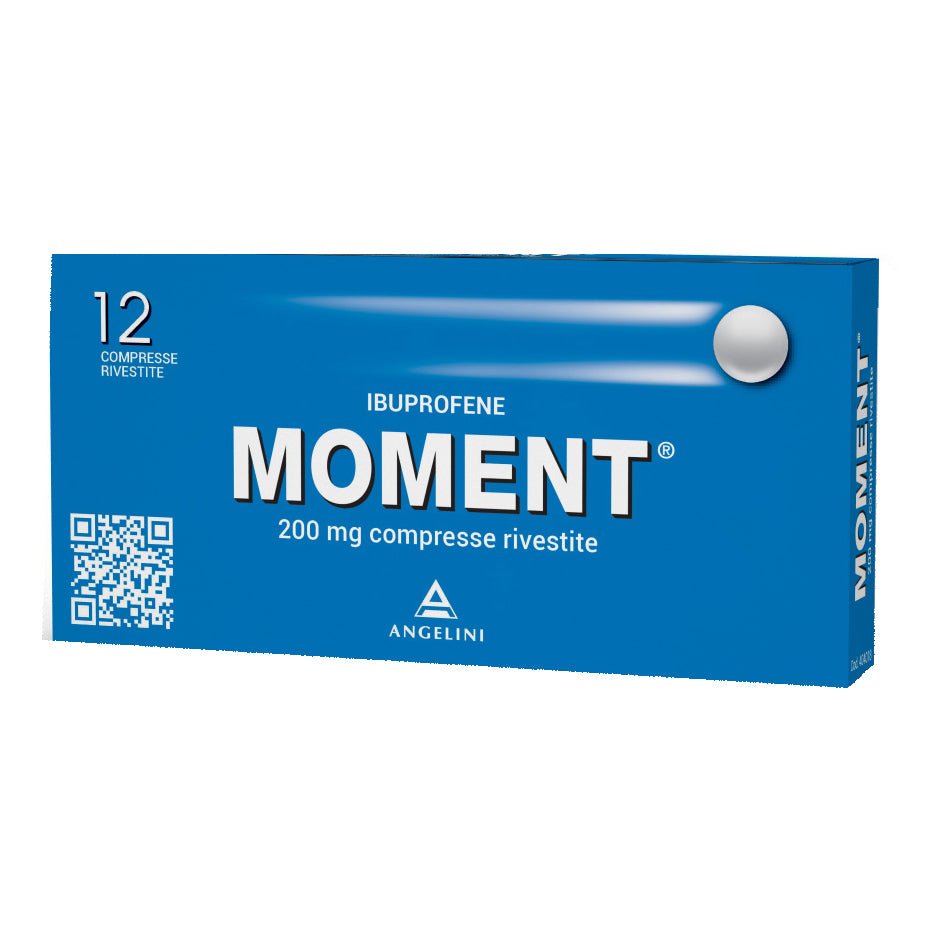
Moment 200 mg 12 coated tablets
Moment 200 mg 12 coated tablets

Moment 200mg it's a anti-inflammatory e analgesic based on ibuprofen, indicated for symptomatic treatment of pain (headache, toothache, muscle and joint pain, menstrual pain) and to reduce fever and symptoms of flu states. Le 24 coated tablets for oral use they guarantee rapid action. Read the leaflet carefully.
Couldn't load pickup availability

NET WEIGHT OF THE PRODUCT
NET WEIGHT OF THE PRODUCT
12ct
EAN
EAN
025669019
MINSAN
MINSAN
025669019
INDICATIONS
Pain of various origins and nature (headache, toothache, neuralgia, osteo-articular and muscular pain, menstrual pain). Adjuvant in the symptomatic treatment of fever and flu.
ACTIVE INGREDIENTS
Each coated tablet contains: Active ingredient: ibuprofen 200 mg. For the full list of excipients see section 6.1.
EXCIPIENTS
Corn starch, sodium carboxymethyl starch, povidone, colloidal anhydrous silica, talc, hydroxypropyl cellulose, gum arabic, sucrose, Macrogol 6000, light magnesium carbonate, titanium dioxide.
CONTRAINDICATIONS AND SIDE EFFECTS
• Do not administer to children under 12 years of age. • Pregnancy and breastfeeding. • Hypersensitivity to the active ingredient, to other antirheumatic drugs (acetylsalicylic acid, etc.) or to any of the excipients. • Active or severe gastroduodenal ulcer or other gastropathies. • History of gastrointestinal hemorrhage or perforation related to previous active treatment or history of recurrent peptic hemorrhage/ulcer (two or more distinct episodes of demonstrated ulceration or bleeding). • Severe hepatic or renal insufficiency. • Severe heart failure.
DOSAGE
Adults and adolescents over 12 years: 1–2 tablets, 2–3 times a day. Do not exceed the dose of 6 tablets per day. If the use of the medicine is necessary for more than 3 days in adolescents, or in the case of worsening of symptoms, the doctor should be consulted. Do not exceed the recommended doses; in particular elderly patients should stick to the minimum dosages indicated above. Take the product on a full stomach.
CONSERVATION
This medicine does not require any particular storage temperature.
WARNINGS
• In asthmatic patients the product must be used with caution, after consulting the doctor. • The use of Moment, like any drug that inhibits the synthesis of prostaglandins and cyclooxygenase, is not recommended in women who intend to become pregnant. • The administration of Moment should be suspended in women who have fertility problems or who are undergoing fertility investigations. • The use of Moment should be avoided concomitantly with NSAIDs, including selective COX-2 inhibitors. • Side effects can be minimized by using the lowest effective dose for the shortest possible duration of treatment needed to control symptoms (see paragraphs below on gastrointestinal and cardiovascular risks). • Cardiovascular and cerebrovascular effects: clinical studies and epidemiological data suggest that the use of ibuprofen, especially at high doses (2400 mg/day) and for long-term treatments, may be associated with a modest increase in the risk of arterial thrombotic events (e.g. myocardial infarction or stroke). In general, epidemiological studies do not suggest that low doses of ibuprofen (e.g. ≤ 1200 mg/day) are associated with an increased risk of myocardial infarction. • There is a risk of impaired renal function in dehydrated adolescents • Elderly: Elderly patients have an increased frequency of adverse reactions to NSAIDs, especially gastrointestinal haemorrhages and perforations, which may be fatal (see section 4.2). • Gastrointestinal haemorrhage, ulceration and perforation: Gastrointestinal haemorrhage, ulceration and perforation, which may be fatal, have been reported at any time during treatment with all NSAIDs, with or without warning symptoms or previous history of serious gastrointestinal events. • In the elderly and in patients with a history of ulcer, especially if complicated by haemorrhage or perforation (see section 4.3), the risk of gastrointestinal haemorrhage, ulceration or perforation is higher with increased doses of NSAIDs. These patients should start treatment with the lowest available dose. Concomitant use of protective agents (misoprostol or proton pump inhibitors) should be considered for these patients and also for patients taking low doses of aspirin or other drugs that may increase the risk of gastrointestinal events (see below and section 4.5). Patients with a history of gastrointestinal toxicity, particularly elderly, should report any unusual gastrointestinal symptoms (especially gastrointestinal haemorrhage) particularly in the initial stages of treatment. • Carefully monitor patients taking concomitant medications that may increase the risk of ulceration or bleeding, such as oral corticosteroids, anticoagulants such as warfarin, selective serotonin reuptake inhibitors or antiplatelet agents such as aspirin (see section 4.5). • When gastrointestinal bleeding or ulceration occurs in patients taking Moment, treatment should be discontinued. • NSAIDs should be administered with caution to patients with a history of gastrointestinal disease (ulcerative colitis, Crohn's disease) as these conditions may be exacerbated (see section 4.8). • Caution is required before starting treatment in patients with a positive history of hypertension and/or heart failure since fluid retention, hypertension and edema have been reported in association with treatment with NSAIDs. • Serious skin reactions, some of them fatal, including exfoliative dermatitis, Stevens-Johnson syndrome and toxic epidermal necrolysis, have been reported very rarely in association with the use of NSAIDs (see section 4.8). In the early stages of therapy patients appear to be at higher risk: the onset of the reaction occurs in most cases within the first month of treatment. Moment should be discontinued at the first appearance of skin rash, mucosal lesions or any other sign of hypersensitivity. • Moment contains: – sucrose: patients suffering from rare hereditary problems of fructose intolerance, glucose-galactose malabsorption, or sucrase isomaltase insufficiency should not take this medicine.
INTERACTIONS
• Possible interactions with coumarin-type anticoagulants must be kept in mind: patients undergoing treatment with these drugs must consult their doctor before taking the product. It is also advisable to seek medical advice in case of any concomitant therapy before administering the product. • Corticosteroids: increased risk of gastrointestinal ulceration or haemorrhage (see section 4.4). • Anticoagulants: NSAIDs may increase the effects of anticoagulants, such as warfarin (see section 4.4). • Antiplatelet agents and selective serotonin reuptake inhibitors (SSRIs): increased risk of gastrointestinal bleeding (see section 4.4). • Diuretics, ACE inhibitors and Angiotensin II antagonists: NSAIDs can reduce the effect of diuretics and other antihypertensive drugs. In some patients with compromised renal function (e.g. dehydrated patients or elderly patients with compromised renal function) co-administration of an ACE inhibitor or an angiotensin II antagonist and agents that inhibit the cyclo-oxygenase system may lead to further deterioration of renal function, including possible acute renal failure, which is usually reversible. These interactions should be considered in patients taking Moment concomitantly with ACE inhibitors or angiotensin II antagonists. Therefore, the combination should be administered with caution, especially in elderly patients. • Patients should be adequately hydrated and consideration should be given to monitoring renal function after initiation of concomitant therapy. • Experimental data indicate that ibuprofen can inhibit the effects of low-dose acetylsalicylic acid on platelet aggregation when the drugs are administered concomitantly. However, the paucity of data and the uncertainties relating to their application to the clinical situation do not allow definitive conclusions to be drawn for the continuous use of ibuprofen; There appears to be no clinically relevant effects from occasional use of ibuprofen (see section 5.1).
SIDE EFFECTS
Skin effects Sometimes allergic skin rashes may occur (erythema, itching, urticaria). Bullous reactions including Stevens–Johnson syndrome and toxic epidermal necrolysis (very rarely). Gastrointestinal effects The most commonly observed adverse events are gastrointestinal in nature. Peptic ulcers, perforation or gastrointestinal haemorrhage, sometimes fatal, may occur, particularly in the elderly (see section 4.4). After administration of Moment the following have been reported: feeling of weight in the stomach, nausea, vomiting, diarrhoea, flatulence, constipation, dyspepsia, abdominal pain, melena, haematemesis, ulcerative stomatitis, exacerbation of colitis and Crohn's disease (see section 4.4). Less frequently, gastritis has been observed. Cardiovascular effects Edema, hypertension and heart failure have been reported in association with treatment with NSAIDs. Clinical studies and epidemiological data suggest that the use of ibuprofen (especially at high doses 2400 mg/day) and for long-term treatments, may be associated with a modest increase in the risk of arterial thrombotic events (e.g. myocardial infarction or stroke) (see Section 4.4). These phenomena rapidly regress upon suspension of treatment.
OVERDOSE
In case of overdose, gastric lavage and correction of blood electrolytes are indicated. There is no specific antidote for ibuprofen.
PREGNANCY AND BREASTFEEDING
Pregnancy Inhibition of prostaglandin synthesis can negatively affect pregnancy and/or embryo/foetal development. Results of epidemiological studies suggest an increased risk of miscarriage and cardiac malformation and gastroschisis after the use of a prostaglandin synthesis inhibitor in the early stages of pregnancy. The absolute risk of cardiac malformations increased from less than 1% to approximately 1.5%. The risk was thought to increase with the dose and duration of therapy. In animals, the administration of prostaglandin synthesis inhibitors has been shown to cause an increase in pre- and post-implantation loss and embryo-foetal mortality. Furthermore, an increased incidence of various malformations, including cardiovascular malformations, has been reported in animals to which prostaglandin synthesis inhibitors were administered during the organogenetic period. During the third trimester of pregnancy, all inhibitors of prostaglandin synthesis can expose: the fetus to: – cardiopulmonary toxicity (with premature closure of the ductus arteriosus and pulmonary hypertension); – renal dysfunction, which can progress to renal failure with oligo-hydramnios; the mother and the newborn, at the end of pregnancy, to: – possible prolongation of bleeding time, and anti-aggregating effect which can occur even at very low doses; – inhibition of uterine contractions resulting in delayed or prolonged labor.
EFFECTS ON DRIVING ABILITY
As a rule, the use of ibuprofen does not alter the ability to drive or use other machinery. However, patients whose activity requires vigilance should use caution if they notice drowsiness, dizziness or depression during ibuprofen therapy.
OUR PRODUCTS FOR THIS SEASON
-
Curial βeta Dry eye supplement 30 capsules Dr.Tili
Vendor:TilpharmaRegular price €22,50Regular priceUnit price per€22,50Sale price €22,50 -
T - Relaxfast Sleep Supplement 60 Capsules Dr.Tili
Vendor:TilpharmaRegular price €24,50Regular priceUnit price per€24,50Sale price €24,50 -
Face Serum C5 Vitamin C 30ml Dr.Tili Skinlab
Vendor:TilabRegular price €62,50Regular priceUnit price per€62,50Sale price €62,50 -
Dr.Tili Skinlab E15 Vitamin E Face Serum 30ml
Vendor:TilabRegular price €32,50Regular priceUnit price per€32,50Sale price €32,50 -
Vit+ Face Vitamin Cream 50ml Dr.Tili Skinlab
Vendor:TilabRegular price €34,00Regular priceUnit price per€34,00Sale price €34,00 -
Anti-aging Facial Treatment Hyaluronic Acid IAL B3 30ml Dr.Tili Skinlab
Vendor:TilabRegular price €46,00Regular priceUnit price per€46,00Sale price €46,00 -
Body Milk Hydra Milk 200Ml. Dr.Tili Skinlab
Vendor:TilabRegular price €16,90Regular priceUnit price per€16,90Sale price €16,90 -
Facial Cleansing Milk 150ml Dr.Tili Skinlab
Vendor:TilabRegular price €18,90Regular priceUnit price per€18,90Sale price €18,90 -
Soothing Facial Toner 125ml Dr.Tili Skinlab
Vendor:TilabRegular price €14,50Regular priceUnit price per€14,50Sale price €14,50 -
Soothing Face Cream 50ml Dr.Tili Skinlab
Vendor:TilabRegular price €19,50Regular priceUnit price per€19,50Sale price €19,50
















-

ASSISTANCE - TELEPHONE ORDERS
-

SHIPPING
Shipping to Italy 24/48H
Delivery also on Saturday and Sunday
Free over €49.90
Shipping to Europe 24/72H
Free over €80 -

SAFETY
The security of your data is important to us!
We strictly comply with the European GDPR regarding
Privacy and processing of personal data
The payments you make on our site are 100% safe and guaranteed -

RETURNS
Fast returns via DIY portal and 14 days to change your mind.
Immediate and free replacements for incorrect or non-compliant products delivered.


