


Polifarma
Ketophtil 0.05% 10 ml eye drops solution
Ketophtil 0.05% 10 ml eye drops solution
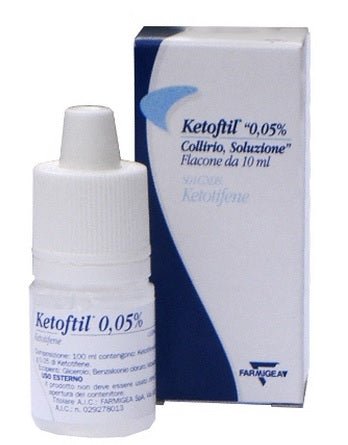
Ketoftil 0.05% eye drops are an ophthalmic antihistamine indicated for the treatment of eye allergies such as acute and chronic conjunctivitis and allergic keratoconjunctivitis . Thanks to ketotifen, it provides rapid relief from itching , redness , burning, and irritation. The practical 10 ml multi-dose bottle is ideal for prolonged and targeted use in controlling the symptoms of seasonal and persistent allergies .
Couldn't load pickup availability

NET WEIGHT OF THE PRODUCT
NET WEIGHT OF THE PRODUCT
10ml
EAN
EAN
029278013
MINSAN
MINSAN
029278013

INDICATIONS
Acute and chronic conjunctivitis and keratoconjunctivitis of an allergic nature (spring, atopic and others).
ACTIVE INGREDIENTS
Ketoftil 0.5 mg/ml eye drops, solution. 1 ml contains 0.69 mg of ketotifen fumarate, equal to 0.5 mg of ketotifen. Ketoftil 0.5 mg/g ophthalmic gel. 1 g contains 0.69 mg of ketotifen fumarate, equal to 0.5 mg of ketotifen. Excipient with known effects The multidose bottle and eye gel contain benzalkonium chloride. For the full list of excipients, see section 6.1.
EXCIPIENTS
Ketoftil 0.5 mg/ml eye drops, solution (multi-dose bottle): Sorbitol, benzalkonium chloride, TS- Polysaccharide and water for injections. Ketoftil 0.5 mg/ml eye drops, solution (single-dose containers): TS-Polysaccharide, sorbitol and water for injections. Ketoftil 0.5 mg/g ophthalmic gel: Hydroxyethyl cellulose, sorbitol, benzalkonium chloride and water for injections.
CONTRAINDICATIONS AND SIDE EFFECTS
Hypersensitivity to ketotifen or to any of the excipients of the product or closely chemically related substances. Generally contraindicated during pregnancy (see section 4.6).
DOSAGE
Ketoftil 0.5 mg/ml eye drops, solution: 1 drop in the conjunctival sac 2 or more times a day, according to medical prescription. Ketoftil 0.5 mg/g ophthalmic gel: 1 drop in the conjunctival sac 2 times a day.
CONSERVATION
None.
WARNINGS
Ketoftil eye drops, solution (multi-dose container) and Ketoftil gel: The formulations of Ketoftil multidose eye drops and Ketoftil gel contain benzalkonium chloride as a preservative which can deposit on soft contact lenses; therefore Ketoftil should not be used if the patient wears this type of lenses. The lenses must be removed before application and you must wait 15 minutes before putting them back on. Products containing benzalkonium chloride as a preservative may discolor soft contact lenses. Benzalkonium chloride can cause ocular irritation, dry eye, alteration of the corneal film and surface. To be used with caution in patients with dry eye and corneal compromise. Patients should be monitored during prolonged use. Ketoftil, in its various pharmaceutical forms, can cause a slight and fleeting burning sensation upon application. Ketoftil ophthalmic gel, due to the nature of its excipients, may cause a slight and transient visual blurring upon application. Ketophtil eye drops, solution and gel: No particular warnings.
INTERACTIONS
If Ketoftil is used concomitantly with other ocular medications, it is necessary to allow at least 5 minutes between applications. Oral administration of ketotifen may potentiate the effects of CNS depressants, antihistamines and alcohol. Although these phenomena have not been observed with Ketoftil, the possibility of such effects cannot be excluded.
SIDE EFFECTS
Adverse reactions from clinical studies (Table 1) are listed by MedDRA system organ class. Within each system organ class, adverse reactions are reported in order of frequency, with the most frequent reactions first. Within each frequency grouping, adverse reactions are presented in order of decreasing seriousness. In addition, the corresponding frequency category for each adverse reaction is based on the following convention (CIOMS III): Very common (≥1/10); common (≥1/100, <1/10); uncommon (≥1/1,000, <1/100), rare (≥1/10,000, <1/1,000); very rare (<1/10,000), not known (frequency cannot be estimated from the available data). Adverse reactions. Immune system disorders. Uncommon: hypersensitivity. Nervous system disorders. Uncommon: headache. Eye pathologies. Common: eye irritation, eye pain, punctate keratitis, punctate erosion of the corneal epithelium; Uncommon: blurred vision, (during instillation), dry eye, eyelid disorders, conjunctivitis, photophobia, conjunctival haemorrhage. Gastrointestinal disorders. Uncommon: dry mouth. Pathologies of the skin and subcutaneous tissue. Uncommon: rash, eczema, urticaria. Systemic pathologies and conditions relating to the administration site. Uncommon: drowsiness. Adverse reactions from post-marketing experience (frequency not known) The following post-marketing adverse reactions have also been observed: • hypersensitivity reactions including local allergic reactions (predominantly contact dermatitis, swelling of the eye area, eyelid pruritus and edema) • systemic allergic reactions including facial swelling/edema (in some cases associated with contact dermatitis) • exacerbations of pre-existing allergic conditions such as asthma and eczema. Reporting of suspected adverse reactions. Reporting suspected adverse reactions that occur after authorization of the medicine is important, as it allows continuous monitoring of the benefit/risk balance of the medicine. Healthcare professionals are asked to report any suspected adverse reactions via the national reporting system at https://www.aifa.gov.it/content/segnalazioni-reazioni-avverse.
OVERDOSE
Multidose Ketophtil No cases of overdose have been reported. Taking this medicine orally is not recommended. Oral ingestion of the contents of the 10 ml multidose bottle or tube is equivalent to 5 mg of ketotifen (the recommended daily dose for children over 3 years is 2 mg). Clinical results indicated no serious signs or symptoms following ingestion of a dose of up to 20 mg of ketotifen. Ketophtil single dose No cases of overdose have been reported. Oral intake of the contents of the single-dose container is equivalent to 0.25 mg of ketotifen (the recommended daily dose for children over 3 years is 2 mg). Clinical results indicated no serious signs or symptoms following ingestion of a dose of up to 20 mg of ketotifen.
PREGNANCY AND BREASTFEEDING
Pregnancy: No data are available on the use of ketotifen during pregnancy. Animal studies with toxic oral doses have shown an increase in pre- and postnatal mortality, but have not shown teratogenic effects. Systemic levels of ketotifen after ophthalmic application are much lower than those achieved after oral administration. However, caution should be used when prescribing this medicine to pregnant women. Breastfeeding: Although data from animal studies after oral administration demonstrate the excretion of the active ingredient in breast milk, it is unlikely that topical administration in women can produce detectable quantities of the active ingredient in breast milk. Ketoftil can be used during breastfeeding. Fertility: There are no data available regarding the effects of ketotifen fumarate on fertility in humans.
EFFECTS ON DRIVING ABILITY
In sensitive subjects, Ketoftil, at the beginning of treatment, could attenuate the reaction capacity. If the patient feels blurred vision or drowsiness following administration of this medicine, they should not drive or use machinery.
OUR PRODUCTS FOR THIS SEASON
-
Curial βeta Dry eye supplement 30 capsules Dr.Tili
Vendor:TilpharmaRegular price €22,50Regular priceUnit price per€22,50Sale price €22,50 -
T - Relaxfast Sleep Supplement 60 Capsules Dr.Tili
Vendor:TilpharmaRegular price €24,50Regular priceUnit price per€24,50Sale price €24,50 -
Face Serum C5 Vitamin C 30ml Dr.Tili Skinlab
Vendor:TilabRegular price €62,50Regular priceUnit price per€62,50Sale price €62,50 -
Dr.Tili Skinlab E15 Vitamin E Face Serum 30ml
Vendor:TilabRegular price €32,50Regular priceUnit price per€32,50Sale price €32,50 -
Vit+ Face Vitamin Cream 50ml Dr.Tili Skinlab
Vendor:TilabRegular price €34,00Regular priceUnit price per€34,00Sale price €34,00 -
Anti-aging Facial Treatment Hyaluronic Acid IAL B3 30ml Dr.Tili Skinlab
Vendor:TilabRegular price €46,00Regular priceUnit price per€46,00Sale price €46,00 -
Body Milk Hydra Milk 200Ml. Dr.Tili Skinlab
Vendor:TilabRegular price €16,90Regular priceUnit price per€16,90Sale price €16,90 -
Facial Cleansing Milk 150ml Dr.Tili Skinlab
Vendor:TilabRegular price €18,90Regular priceUnit price per€18,90Sale price €18,90 -
Soothing Facial Toner 125ml Dr.Tili Skinlab
Vendor:TilabRegular price €14,50Regular priceUnit price per€14,50Sale price €14,50 -
Soothing Face Cream 50ml Dr.Tili Skinlab
Vendor:TilabRegular price €19,50Regular priceUnit price per€19,50Sale price €19,50

















-

ASSISTANCE - TELEPHONE ORDERS
-

SHIPPING
Shipping to Italy 24/48H
Delivery also on Saturday and Sunday
Free over €49.90
Shipping to Europe 24/72H
Free over €80 -

SAFETY
The security of your data is important to us!
We strictly comply with the European GDPR regarding
Privacy and processing of personal data
The payments you make on our site are 100% safe and guaranteed -

RETURNS
Fast returns via DIY portal and 14 days to change your mind.
Immediate and free replacements for incorrect or non-compliant products delivered.


