

Sanofi
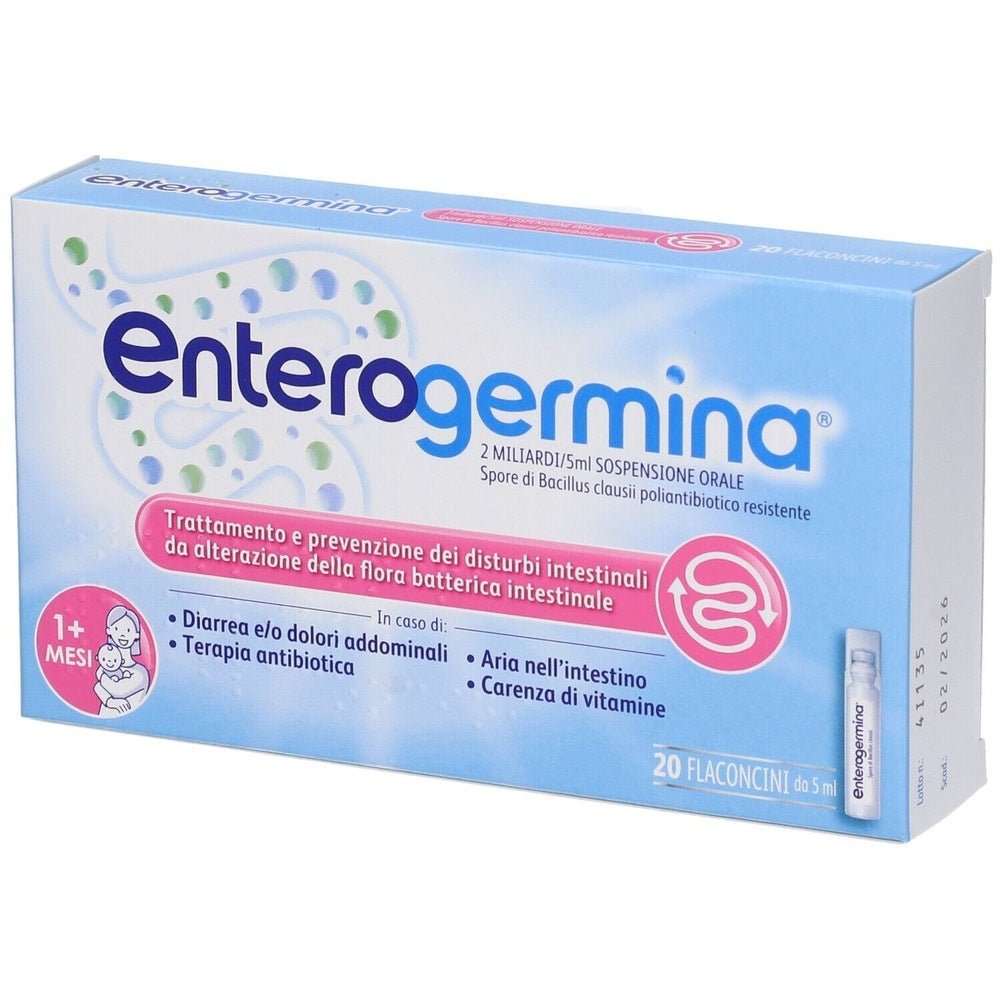
Enterogermina 2 Billion/5 Ml 20 Vials
Enterogermina 2 Billion/5 Ml 20 Vials
Enterogermina 2 Billion/5 ml is a probiotic based on Bacillus clausii indicated for the treatment and prevention of intestinal dysbiosis and consequent vitamin deficiencies . Useful in cases of antibiotic therapy , acute and chronic gastrointestinal disorders in adults, children and infants, it promotes the restoration of the balance of the intestinal bacterial flora .
Couldn't load pickup availability

NET WEIGHT OF THE PRODUCT
NET WEIGHT OF THE PRODUCT
100ml
EAN
EAN
013046040
MINSAN
MINSAN
013046040
INDICATIONS
Treatment and prophylaxis of intestinal dysmicrobism and consequent endogenous vitamin deficiency. Therapy assists the restoration of the intestinal microbial flora, altered during antibiotic or chemotherapy treatments. Acute and chronic gastrointestinal disorders in infants, attributable to intoxications or intestinal dysmicrobisms and vitamin deficiency.
ACTIVE INGREDIENTS
One vial contains: Active ingredient Spores of Bacillus clausii resistant polyantibiotic (SIN, O/C, T, N/R strains): 2 billion One hard capsule contains: Active ingredient Spores of Bacillus clausii resistant polyantibiotic (SIN, O/C, T, N/R strains): 2 billion For the complete list of excipients, see section 6.1
EXCIPIENTS
Vials: purified water. Capsules: Microcrystalline cellulose, Magnesium stearate, Gelatin, Titanium dioxide (E171), Purified water.
CONTRAINDICATIONS AND SIDE EFFECTS
Hypersensitivity to the active substance or to any of the excipients listed in paragraph 6.1.
DOSAGE
Adults: 2-3 vials per day or 2-3 capsules per day. Children: 1-2 vials per day or 1-2 capsules per day. Infants: 1-2 vials per day. Vials: administration at regular intervals. Take the contents of the vial as is or diluted in water or other drinks (e.g. milk, tea, orange juice). Capsules: swallow with a sip of water or other beverage. Especially in younger children, in case of difficulty swallowing hard capsules, it is advisable to use the oral suspension. This medicine is for oral use only. Do not inject or administer in any other way (see section 4.4).
CONSERVATION
Store below 30°C.
WARNINGS
Special warnings Bacteremia/sepsis Post-marketing cases of bacteremia, septicemia and sepsis have been reported in immunocompromised or seriously ill patients and in preterm infants. In the case of some critically ill patients, the outcome was fatal. ENTEROGERMINA should be avoided in these patient groups (see section 4.8). This medicine is for oral use only. Do not inject or administer by other routes. Incorrect use of the medicine has caused serious anaphylactic reactions such as anaphylactic shock. Precautions for use During antibiotic therapy it is recommended to administer the preparation in the interval between one antibiotic administration and the next. The possible presence of visible corpuscles in the vials of ENTEROGERMINA is due to aggregates of spores of Bacillus clausii; it is therefore not an indication of an altered product. Shake the vial before use.
INTERACTIONS
No interaction studies have been performed.
SIDE EFFECTS
The following side effects have been observed during treatment with this medicinal product, classified according to the MedDRA classification by organ class and according to the following frequency classes: Very common (≥1/10); common (≥1/100,<1/10); uncommon (≥1/1,000, <1/100); rare (≥1/10,000,<1/1,000); very rare <1/10,000); not known (frequency cannot be estimated from the available data).
Infections and infestations - Not known: Bacteremia, septicemia and sepsis (in immunocompromised or seriously ill patients) (see section 4.4).
Skin and subcutaneous tissue disorders - Not known: hypersensitivity reactions, including rash, urticaria and angioedema.
Reporting of suspected adverse reactions. Reporting suspected adverse reactions that occur after authorization of the medicine is important, as it allows continuous monitoring of the benefit/risk balance of the medicine. Healthcare professionals are asked to report any suspected adverse reactions via the national reporting system at https://www.aifa.gov.it/content/segnalazioni-reazioni-avverse.
OVERDOSE
No cases of overdose have been reported.
PREGNANCY AND BREASTFEEDING
Pregnancy There are no data available regarding the use of Enterogermina in pregnant women; therefore it is not possible to draw conclusions on the safety of the use of Enterogermina during pregnancy. Enterogermina should be used during pregnancy only if the potential benefits to the mother outweigh the potential risks, including those to the fetus. Breastfeeding There are no data available regarding the use of Enterogermina during breastfeeding regarding the composition of breast milk and the effects on the baby. It is not possible to draw any conclusions about the safety of using Enterogermina during breastfeeding. Enterogermina should be used during breastfeeding only if the potential benefits to the mother outweigh the potential risks, including those to the breast-fed baby. Fertility No data are available on the effect of Enterogermina on human fertility.
EFFECTS ON DRIVING ABILITY
Enterogermina does not alter the ability to drive or use machines.
OUR PRODUCTS FOR THIS SEASON
-
Curial βeta Dry eye supplement 30 capsules Dr.Tili
Vendor:TilpharmaRegular price €22,50Regular priceUnit price per€22,50Sale price €22,50 -
T - Relaxfast Sleep Supplement 60 Capsules Dr.Tili
Vendor:TilpharmaRegular price €24,50Regular priceUnit price per€24,50Sale price €24,50 -
Face Serum C5 Vitamin C 30ml Dr.Tili Skinlab
Vendor:TilabRegular price €62,50Regular priceUnit price per€62,50Sale price €62,50 -
Dr.Tili Skinlab E15 Vitamin E Face Serum 30ml
Vendor:TilabRegular price €32,50Regular priceUnit price per€32,50Sale price €32,50 -
Vit+ Face Vitamin Cream 50ml Dr.Tili Skinlab
Vendor:TilabRegular price €34,00Regular priceUnit price per€34,00Sale price €34,00 -
Anti-aging Facial Treatment Hyaluronic Acid IAL B3 30ml Dr.Tili Skinlab
Vendor:TilabRegular price €46,00Regular priceUnit price per€46,00Sale price €46,00 -
Body Milk Hydra Milk 200Ml. Dr.Tili Skinlab
Vendor:TilabRegular price €16,90Regular priceUnit price per€16,90Sale price €16,90 -
Facial Cleansing Milk 150ml Dr.Tili Skinlab
Vendor:TilabRegular price €18,90Regular priceUnit price per€18,90Sale price €18,90 -
Soothing Facial Toner 125ml Dr.Tili Skinlab
Vendor:TilabRegular price €14,50Regular priceUnit price per€14,50Sale price €14,50 -
Soothing Face Cream 50ml Dr.Tili Skinlab
Vendor:TilabRegular price €19,50Regular priceUnit price per€19,50Sale price €19,50
















-

ASSISTANCE - TELEPHONE ORDERS
-

SHIPPING
Shipping to Italy 24/48H
Delivery also on Saturday and Sunday
Free over €49.90
Shipping to Europe 24/72H
Free over €80 -

SAFETY
The security of your data is important to us!
We strictly comply with the European GDPR regarding
Privacy and processing of personal data
The payments you make on our site are 100% safe and guaranteed -

RETURNS
Fast returns via DIY portal and 14 days to change your mind.
Immediate and free replacements for incorrect or non-compliant products delivered.


