

Reckitt Benckiser
BenactivDolMed 8, 75 mg/dose 15 ml lemon and honey oral spray
BenactivDolMed 8, 75 mg/dose 15 ml lemon and honey oral spray
BenactivDolMed 8.75 mg/dose lemon and honey oral spray is an over-the-counter flurbiprofen -based medication indicated for the symptomatic treatment of sore throat in adults. Thanks to its anti-inflammatory and analgesic action, it offers rapid relief from pain , irritation , and difficulty swallowing . The practical 15 ml lemon and honey-flavored spray format ensures targeted and pleasant application, with up to 83 sprays .
Couldn't load pickup availability

NET WEIGHT OF THE PRODUCT
NET WEIGHT OF THE PRODUCT
EAN
EAN
048231017
MINSAN
MINSAN
048231017
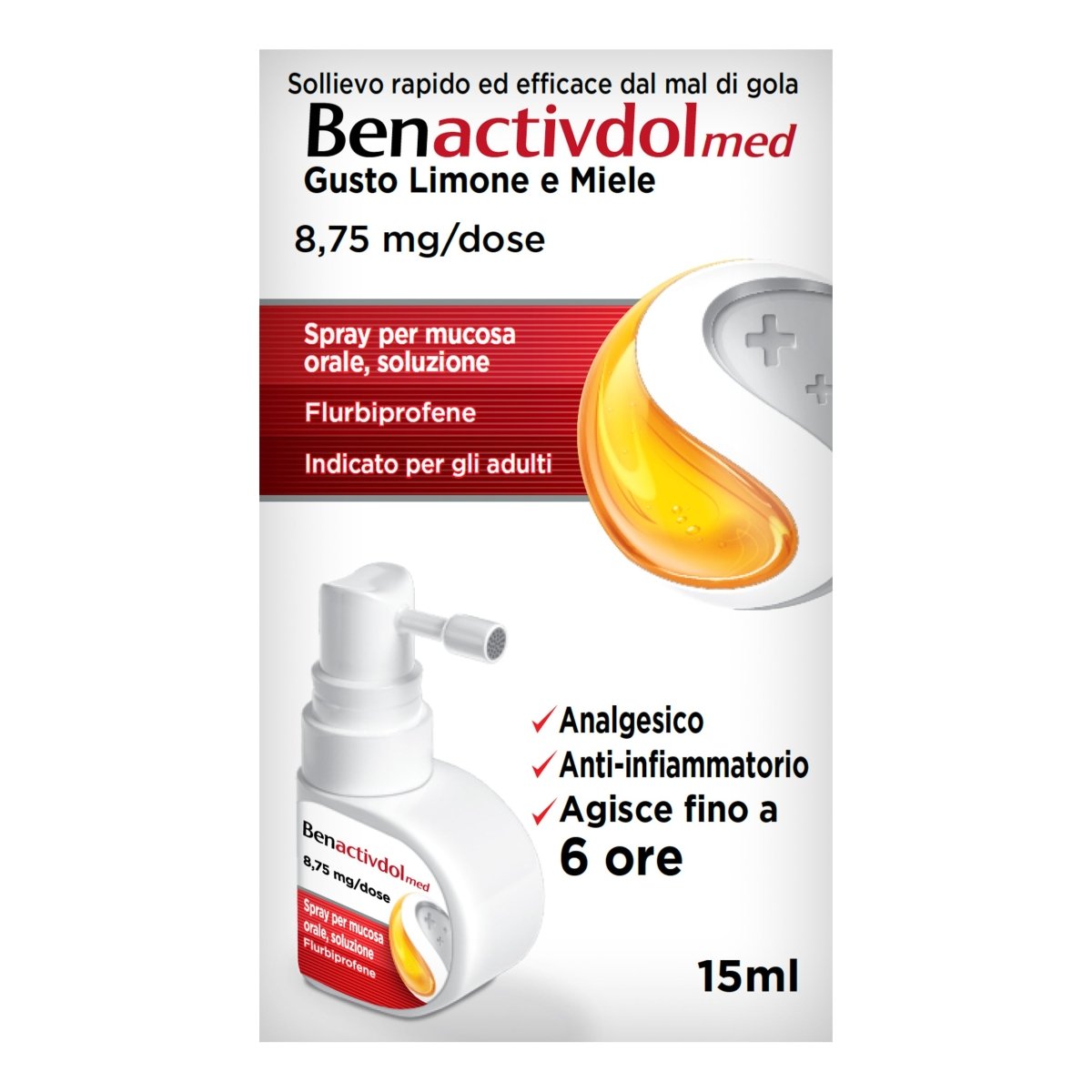
BenactivDolMed 8.75 mg/dose 15 ml oral spray lemon and honey is an over-the-counter medicine specifically formulated for the symptomatic treatment of acute pain in sore throat in adults. Thanks to the presence of flurbiprofen , an active ingredient with anti-inflammatory and analgesic action , this oral spray acts directly on the oral mucosa and the inflamed area, offering rapid and targeted relief from the symptoms of sore throat , pain and difficulty swallowing .
The practical 15 ml format with dosing pump allows for simple and precise use, guaranteeing up to 83 sprays. The lemon and honey flavour makes the application particularly pleasant, promoting the continuity of the treatment even in the case of intense throat inflammation . BenactivDolMed is indicated for local use and offers rapid action, ideal for those seeking an effective remedy against sore throat and associated discomfort.
By choosing BenactivDolMed lemon and honey oral spray , you can count on a targeted treatment for throat relief , with a formulation designed for adults that acts quickly against pain, inflammation and irritation . Perfect for those who want a practical, effective and pleasant-tasting product , to always carry with you to deal with the symptoms of a sore throat at any time of the day.
ACTIVE INGREDIENTS
Active ingredients contained in BenactivDolMed 8.75 mg/dose 15 ml oral spray lemon and honey - What is the active ingredient of BenactivDolMed 8.75 mg/dose 15 ml oral spray lemon and honey?
One spray contains 2.92 mg Flurbiprofen, a dose equal to three sprays contains 8.75 mg Flurbiprofen, corresponding to 16.2 mg/ml Flurbiprofen. Excipients with known effect: Methyl parahydroxy benzoate (E218) 1.181 mg/dose Propyl parahydroxy benzoate (E216) 0.2362 mg/dose The flavours contain allergens (lemon flavour and honey flavour) For the full list of excipients, see section 6.1.EXCIPIENTS
Composition of BenactivDolMed 8.75 mg/dose 15 ml oral spray lemon and honey - What does BenactivDolMed 8.75 mg/dose 15 ml oral spray lemon and honey contain?
Betadex, Disodium phosphate dodecahydrate, Citric acid monohydrate, Methyl parahydroxybenzoate (E218), Propyl parahydroxybenzoate (E216), Sodium hydroxide, Honey flavour, Lemon flavour, N,2,3-Trimethyl-2-isopropylbutanamide, Sodium saccharin (E954), Hydroxypropylbetadex, Purified water. Qualitative composition of Honey flavour: Flavouring substance(s), Flavouring preparation(s), Propylene glycol (E1520). Qualitative composition of Lemon flavour: Flavouring substance(s), Flavouring preparation(s), Propylene glycol (E1520).DIRECTIONS
Therapeutic indications BenactivDolMed 8.75 mg/dose 15 ml oral spray lemon and honey - Why is BenactivDolMed 8.75 mg/dose 15 ml oral spray lemon and honey used? What is it used for?
Benactivdolmed is indicated for the short-term symptomatic treatment of acute pain in sore throat in adults.CONTRAINDICATIONS AND SIDE EFFECTS
Contraindications BenactivDolMed 8.75 mg/dose 15 ml oral spray lemon and honey - When should BenactivDolMed 8.75 mg/dose 15 ml oral spray lemon and honey not be used?
• Hypersensitivity to the active substance or to any of the excipients listed in section 6.1. • Patients who have previously shown hypersensitivity reactions (e.g. asthma, bronchospasm, rhinitis, angioedema or urticaria) in response to acetylsalicylic acid or other NSAIDs. • Active or previous recurrent peptic ulcer/haemorrhage (two or more distinct episodes of proven ulceration) and intestinal ulceration. • History of gastrointestinal bleeding or perforation, severe colitis, haemorrhagic or haematopoietic disorders related to previous NSAID therapy. • Last trimester of pregnancy (see section 4.6). • Severe cardiac insufficiency, severe renal insufficiency or severe hepatic insufficiency (see section 4.4). • Children and adolescents under 18 years of age.DOSAGE
Quantity and method of taking BenactivDolMed 8.75 mg/dose 15 ml oral spray lemon and honey - How to take BenactivDolMed 8.75 mg/dose 15 ml oral spray lemon and honey?
Dosage : For short-term treatment only. Adults aged 18 years and over: one dose (3 sprays) administered into the back of the throat every 3-6 hours as needed, up to a maximum of 5 doses in a 24-hour period. Paediatric population : The safety and efficacy of Benactivdolmed in children or adolescents under 18 years of age have not been established. Elderly patients : A general dosage recommendation cannot be given, as clinical experience to date is limited. Elderly patients are at increased risk of serious consequences in the event of adverse reactions. The lowest effective dose for the shortest duration necessary to control symptoms should be administered (see section 4.4). Method of administration : For oromucosal administration. Do not inhale during spraying. This medicinal product should be used for a maximum of 3 days. Before first use, activate the pump by pointing the nozzle away from your body and spraying at least four times, until a fine, uniform mist is released. The pump is now activated and ready for use. Between uses, point the nozzle away from your body and spray a small amount of product, to ensure that the mist is fine and uniform. Always ensure that the mist is fine and uniform before using the product.CONSERVATION
Storage BenactivDolMed 8.75 mg/dose 15 ml oral spray lemon and honey - How do you store BenactivDolMed 8.75 mg/dose 15 ml oral spray lemon and honey?
Do not refrigerate or freeze.WARNINGS
Warnings BenactivDolMed 8.75 mg/dose 15 ml oral spray lemon and honey - About BenactivDolMed 8.75 mg/dose 15 ml oral spray lemon and honey it is important to know that:
Undesirable effects may be minimised by using the lowest effective dose for the shortest duration necessary to control symptoms. Infections : Since exacerbation of infectious inflammation (e.g. development of necrotising fasciitis) has been described in isolated cases in temporal association with systemic use of drugs belonging to the class of NSAIDs, the patient is advised to consult a doctor immediately if signs of a bacterial infection appear or worsen during therapy with flurbiprofen spray. Consideration should be given to whether initiation of antibiotic therapy is indicated. In case of purulent bacterial pharyngitis/tonsillitis, the patient is advised to consult a doctor for a reassessment of treatment. Treatment should be administered for a maximum of 3 days. If symptoms worsen or new symptoms appear, treatment should be reassessed. If irritation of the mouth occurs, treatment with flurbiprofen should be discontinued. Elderly population : The elderly show an increased frequency of adverse reactions to NSAIDs, especially gastrointestinal bleeding and perforation, which may be fatal. Respiratory effects : Bronchospasm may be precipitated in patients suffering from or with a previous history of bronchial asthma or allergic disease. Flurbiprofen spray should be used with caution in these patients. Other NSAIDs : The use of flurbiprofen spray should be avoided in conjunction with other NSAIDs, including cyclooxygenase-2 selective inhibitors (see section 4.5). Systemic lupus erythematosus (SLE) and mixed connective tissue disease : Patients with systemic lupus erythematosus (SLE) and mixed connective tissue disease may be at increased risk of aseptic meningitis (see section 4.8), however this effect is not usually seen with products intended for limited and short-term use such as flurbiprofen spray. Cardiovascular, renal and hepatic impairment : NSAIDs have been reported to cause various forms of nephrotoxicity, including interstitial nephritis, nephrotic syndrome and renal failure. Administration of an NSAID may cause a dose-dependent reduction in prostaglandin formation and precipitate renal failure. Patients most at risk of developing this reaction are those with impaired renal function, cardiac impairment, hepatic dysfunction, those on diuretic therapy and the elderly; however, this effect is not usually seen with products intended for limited and short-term use such as flurbiprofen spray. Hepatic effects : Mild to moderate hepatic dysfunction (see sections 4.3 and 4.8). Cardiovascular and cerebrovascular effects : Caution is advised before initiating treatment in patients with a history of hypertension and/or heart failure (consult your doctor or pharmacist) as fluid retention, hypertension and oedema have been reported in association with NSAID therapy. Clinical trials and epidemiological data suggest that use of some NSAIDs (particularly at high doses and in long-term treatment) may be associated with a small increased risk of arterial thrombotic events (for example myocardial infarction or stroke). There are insufficient data to exclude such a risk with flurbiprofen when administered at a daily dose not exceeding 5 doses (3 actuations for each dose). Effects on the nervous system : Analgesic-induced headache - Headache may occur in case of prolonged or inappropriate use of analgesics, which should not be treated by increasing the dose of the medicinal product. Gastrointestinal effects : NSAIDs should be administered with caution to patients with a history of gastrointestinal disease (ulcerative colitis, Crohn's disease) as these conditions may be exacerbated (see section 4.8). Gastrointestinal bleeding, ulceration or perforation, which may be fatal, has been reported with all NSAIDs at any time during treatment, with or without warning symptoms or a previous history of serious GI events. The risk of GI bleeding, ulceration or perforation is higher with increasing NSAID doses, in patients with a history of ulcer, particularly if complicated with haemorrhage or perforation (see section 4.3), and in the elderly; however, this effect is not usually seen with products intended for limited short-term use such as flurbiprofen spray. Patients with a history of GI toxicity, particularly when elderly, should report any unusual abdominal symptoms (especially GI bleeding) to their doctor. Caution should be advised in patients receiving concomitant medications which could increase the risk of ulceration or bleeding, such as oral corticosteroids, anticoagulants such as warfarin, selective serotonin reuptake inhibitors or anti-platelet agents such as acetylsalicylic acid (see section 4.5). If gastrointestinal bleeding or ulceration occurs in patients receiving flurbiprofen, the treatment should be withdrawn. Haematological effects : Flurbiprofen, like other NSAIDs, can inhibit platelet aggregation and prolong bleeding time. Flurbiprofen spray should be used with caution in patients with abnormal bleeding potential. Dermatological effects : Serious skin reactions, some of them fatal, including exfoliative dermatitis, Stevens-Johnson syndrome and toxic epidermal necrolysis have been reported very rarely in association with the use of NSAIDs (see section 4.8). Flurbiprofen spray should be discontinued at the first appearance of skin rash, mucosal lesions or any other sign of hypersensitivity. This product contains methyl parahydroxybenzoate and propyl parahydroxybenzoate which may cause allergic reactions (sometimes delayed). This product contains less than 1 mmol (23 mg) sodium per dose, i.e. essentially “sodium-free”. Flavours containing allergens: This product contains flavours containing anisyl alcohol, citral, citronellol, d-Limonene, geraniol and linalool. Anisyl alcohol, citral, citronellol, d-Limonene, geraniol, linalool may cause allergic reactions.INTERACTIONS
Interactions BenactivDolMed 8.75 mg/dose 15 ml oral spray lemon and honey - Which medicines or foods can modify the effect of BenactivDolMed 8.75 mg/dose 15 ml oral spray lemon and honey?
| Flurbiprofen should be avoided in association with : | |
| Other NSAIDs including selective cyclooxygenase-2 inhibitors : | Avoid concomitant use of two or more NSAIDs, as this may increase the risk of adverse effects (especially gastrointestinal adverse events such as ulcers and bleeding) (see section 4.4). |
| Acetylsalicylic acid (low doses) : | Unless taking low dose aspirin (not exceeding 75 mg/day) has been recommended by your doctor, as the risk of adverse events may increase (see section 4.4). |
| Flurbiprofen should be used with caution in association with : | |
| Anticoagulants : | NSAIDs may enhance the effects of anticoagulants such as warfarin (see section 4.4). |
| Antiplatelet agents : | There is an increased risk of gastrointestinal ulceration or bleeding (see section 4.4). |
| Antihypertensive drugs (Diuretics, ACE inhibitors, angiotensin II antagonists) : | NSAIDs may reduce the effect of diuretics and other antihypertensive drugs may potentiate nephrotoxicity caused by cyclooxygenase inhibition, especially in patients with impaired renal function. |
| Alcohol : | May increase the risk of adverse reactions, especially bleeding in the gastrointestinal tract. |
| Cardiac glycosides : | NSAIDs may exacerbate heart failure, reduce GFR (glomerular filtration rate) and increase plasma glycoside levels - adequate monitoring and, if necessary, dose adjustment is recommended. |
| Cyclosporine : | There is an increased risk of nephrotoxicity. |
| Corticosteroids : | There is an increased risk of gastrointestinal ulceration or bleeding (see section 4.4). |
| Lithium : | There may be an increase in serum lithium levels - adequate monitoring and, if necessary, dose adjustment is recommended. |
| Methotrexate : | Administration of NSAIDs within 24 hours before or after methotrexate administration may lead to elevated methotrexate concentrations and an increase in its toxic effects. |
| Mifepristone : | NSAIDs should not be used for 8 - 12 days after mifepristone administration, as NSAIDs may reduce the effect of mifepristone. |
| Oral antidiabetics : | Alterations in blood glucose levels have been reported (it is recommended to increase the frequency of checks). |
| Phenytoin : | Serum phenytoin levels may increase - adequate monitoring and, if necessary, dose adjustment is recommended. |
| Potassium-sparing diuretics : | Concomitant use may cause hyperkalemia. |
| Probenecid and Sulfinpyrazone : | Medicines containing probenecid and sulfinpyrazone may delay the excretion of flurbiprofen. |
| Quinolone antibiotics : | Animal data indicate that NSAIDs may increase the risk of convulsions associated with quinolone antibiotics. Patients taking NSAIDs and quinolones may be at increased risk of developing convulsions. |
| Selective serotonin reuptake inhibitors (SSRIs) : | There is an increased risk of gastrointestinal ulceration or bleeding (see section 4.4). |
| Tacrolimus : | There is a potential for an increased risk of nephrotoxicity when NSAIDs are administered with tacrolimus. |
| Zidovudine : | There is an increased risk of haematological toxicity when NSAIDs are administered with zidovudine. |
SIDE EFFECTS
Like all medicines, BenactivDolMed 8.75 mg/dose 15 ml oral spray lemon and honey can cause side effects - What are the side effects of BenactivDolMed 8.75 mg/dose 15 ml oral spray lemon and honey?
Hypersensitivity reactions to NSAIDs have been reported and may consist of: (a) non-specific allergic reactions and anaphylaxis; (b) respiratory tract reactivity, e.g. asthma, aggravated asthma, bronchospasm, dyspnoea; (c) various skin reactions, e.g. pruritus, urticaria, angioedema and, more rarely, exfoliative and bullous dermatoses (including epidermal necrolysis and erythema multiforme). Oedema, hypertension and cardiac failure have been reported in association with NSAID treatment. Data are insufficient to exclude this risk with the use of flurbiprofen oromucosal spray, solution. The list of adverse effects reported below refers to those reported with flurbiprofen, used at doses consistent with the OTC classification and for a short period . (Very common (≥1/10), Common (≥1/100 to <1/10), Uncommon (≥1/1,000 to <1/100), Rare (≥1/10,000 to <1/1,000), Very rare (<1/10,000), not known (cannot be estimated from the available data)). Blood and lymphatic system disorders . Not known: anaemia, thrombocytopenia. Cardiovascular and cerebrovascular disorders . Not known: oedema, hypertension, cardiac failure. Nervous system disorders . Common: dizziness, headache, paraesthesia; Uncommon: somnolence. Respiratory, thoracic and mediastinal disorders . Common: throat irritation; Uncommon: exacerbation of asthma and bronchospasm, dyspnoea, wheezing, oropharyngeal vesicular eruption, hypoaesthesia of the pharynx. Gastrointestinal disorders . Common: diarrhoea, mouth ulceration, nausea, oral pain, oral paraesthesia, oropharyngeal pain, oral discomfort (sensation of heat or burning, tingling of the mouth); Uncommon: abdominal distension, abdominal pain, constipation, dry mouth, dyspepsia, flatulence, glossodynia, dysgeusia, oral dysaesthesia, vomiting. Skin and subcutaneous tissue disorders . Uncommon: rashes of various types, pruritus; Not known: severe forms of skin reactions such as bullous reactions, including Stevens-Johnson syndrome and toxic epidermal necrosis. General disorders and administration site conditions . Uncommon: pyrexia, pain. Immune system disorders . Rare: anaphylactic reaction. Psychiatric disorders . Uncommon: insomnia. Hepatobiliary disorders . Not known: hepatitis. Reporting of suspected adverse reactions . Reporting suspected adverse reactions that occur after authorisation of the medicinal product is important. It allows continued monitoring of the benefit/risk balance of the medicinal product. Healthcare professionals are asked to report any suspected adverse reactions via the national reporting system at https://www.aifa.gov.it/content/segnalazioni-reazioni-avverse.OVERDOSE
Overdose BenactivDolMed 8.75 mg/dose 15 ml oral spray lemon and honey - What are the risks of BenactivDolMed 8.75 mg/dose 15 ml oral spray lemon and honey in case of overdose?
Symptoms The majority of patients who have ingested clinically important quantities of NSAIDs will develop no more than nausea, vomiting, epigastric pain, or more rarely diarrhea. Tinnitus, headache, and gastrointestinal bleeding are also possible. In more severe NSAID intoxication, central nervous system toxicity is observed, manifested by drowsiness, occasionally excitation, blurred vision, and disorientation or coma. Occasionally, patients develop convulsions. In severe NSAID intoxication, metabolic acidosis may occur and the prothrombin time/INR may be prolonged, probably due to interference with the action of circulating coagulation factors. Acute renal failure and liver damage may occur. Exacerbation of asthma is possible in asthmatics. Treatment Treatment should be symptomatic and supportive and should include maintaining a patent airway and monitoring cardiac function and vital signs until stabilization. Oral administration of activated charcoal or gastric lavage and, if necessary, correction of serum electrolytes should be considered if the patient presents within 1 hour of ingestion of a potentially toxic amount. Seizures, if frequent or prolonged, should be treated with intravenous diazepam or lorazepam. Administer bronchodilators for asthma. There is no specific antidote for flurbiprofen.PREGNANCY AND BREASTFEEDING
If you are pregnant or breast-feeding, think you may be pregnant or are planning to have a baby, ask your doctor for advice before taking BenactivDolMed 8.75 mg/dose 15 ml oral spray lemon and honey
Pregnancy : Inhibition of prostaglandin synthesis may adversely affect the pregnancy and/or the embryonic/foetal development. Data from epidemiological studies suggest an increased risk of miscarriage, cardiac malformation and gastroschisis following use of a prostaglandin synthesis inhibitor in early pregnancy. The absolute risk for cardiovascular malformation was increased from less than 1%, up to approximately 1.5%. The risk is believed to increase with dose and duration of therapy. In animals, administration of a prostaglandin synthesis inhibitor has been shown to result in increased pre- and post-implantation loss and embryo-foetal lethality. In addition, an increased incidence of various malformations, including cardiovascular, has been reported in animals given a prostaglandin synthesis inhibitor during the organogenetic period. Flurbiprofen should not be administered during the first and second trimester of pregnancy. During the third trimester of pregnancy, all prostaglandin synthesis inhibitors may expose • the fetus to: - cardiopulmonary toxicity (with premature closure of the ductus arteriosus and pulmonary hypertension); - renal dysfunction which may progress to renal failure with oligo-hydramnios; • the mother and the neonate, at the end of pregnancy, to: - possible prolongation of bleeding time, an anti-aggregating effect which may occur even at very low doses. - inhibition of uterine contractions resulting in delayed or prolonged labor. Consequently, flurbiprofen is contraindicated during the third trimester of pregnancy (see section 4.3). Breast-feeding : In a limited number of studies, flurbiprofen appears in breast milk at very low concentrations and is unlikely to have any adverse effects on the breast-fed infant. However, due to the possible adverse effects of NSAIDs on breast-fed infants, the use of flurbiprofen spray by nursing mothers is not recommended. Fertility : There is some evidence to suggest that cyclooxygenase/prostaglandin synthesis inhibitors may cause impairment of female fertility by an effect on ovulation. This is reversible upon discontinuation of treatment.DRIVING AND USE OF MACHINERY
Taking BenactivDolMed 8.75 mg/dose 15 ml oral spray lemon and honey before driving or using machines - Does BenactivDolMed 8.75 mg/dose 15 ml oral spray lemon and honey affect driving or using machines?
No studies on the ability to drive and use machines have been performed. Dizziness, drowsiness and visual disturbances are possible side effects following the intake of NSAIDs. If these occur, the patient should not drive or operate machinery.OUR PRODUCTS FOR THIS SEASON
-
Curial βeta Dry eye supplement 30 capsules Dr.Tili
Vendor:TilpharmaRegular price €22,50Regular priceUnit price per€22,50Sale price €22,50 -
T - Relaxfast Sleep Supplement 60 Capsules Dr.Tili
Vendor:TilpharmaRegular price €24,50Regular priceUnit price per€24,50Sale price €24,50 -
Face Serum C5 Vitamin C 30ml Dr.Tili Skinlab
Vendor:TilabRegular price €62,50Regular priceUnit price per€62,50Sale price €62,50 -
Dr.Tili Skinlab E15 Vitamin E Face Serum 30ml
Vendor:TilabRegular price €32,50Regular priceUnit price per€32,50Sale price €32,50 -
Vit+ Face Vitamin Cream 50ml Dr.Tili Skinlab
Vendor:TilabRegular price €34,00Regular priceUnit price per€34,00Sale price €34,00 -
Anti-aging Facial Treatment Hyaluronic Acid IAL B3 30ml Dr.Tili Skinlab
Vendor:TilabRegular price €46,00Regular priceUnit price per€46,00Sale price €46,00 -
Body Milk Hydra Milk 200Ml. Dr.Tili Skinlab
Vendor:TilabRegular price €16,90Regular priceUnit price per€16,90Sale price €16,90 -
Facial Cleansing Milk 150ml Dr.Tili Skinlab
Vendor:TilabRegular price €18,90Regular priceUnit price per€18,90Sale price €18,90 -
Soothing Facial Toner 125ml Dr.Tili Skinlab
Vendor:TilabRegular price €14,50Regular priceUnit price per€14,50Sale price €14,50 -
Soothing Face Cream 50ml Dr.Tili Skinlab
Vendor:TilabRegular price €19,50Regular priceUnit price per€19,50Sale price €19,50

















-

ASSISTANCE - TELEPHONE ORDERS
-

SHIPPING
Shipping to Italy 24/48H
Delivery also on Saturday and Sunday
Free over €49.90
Shipping to Europe 24/72H
Free over €80 -

SAFETY
The security of your data is important to us!
We strictly comply with the European GDPR regarding
Privacy and processing of personal data
The payments you make on our site are 100% safe and guaranteed -

RETURNS
Fast returns via DIY portal and 14 days to change your mind.
Immediate and free replacements for incorrect or non-compliant products delivered.


