

Bayer
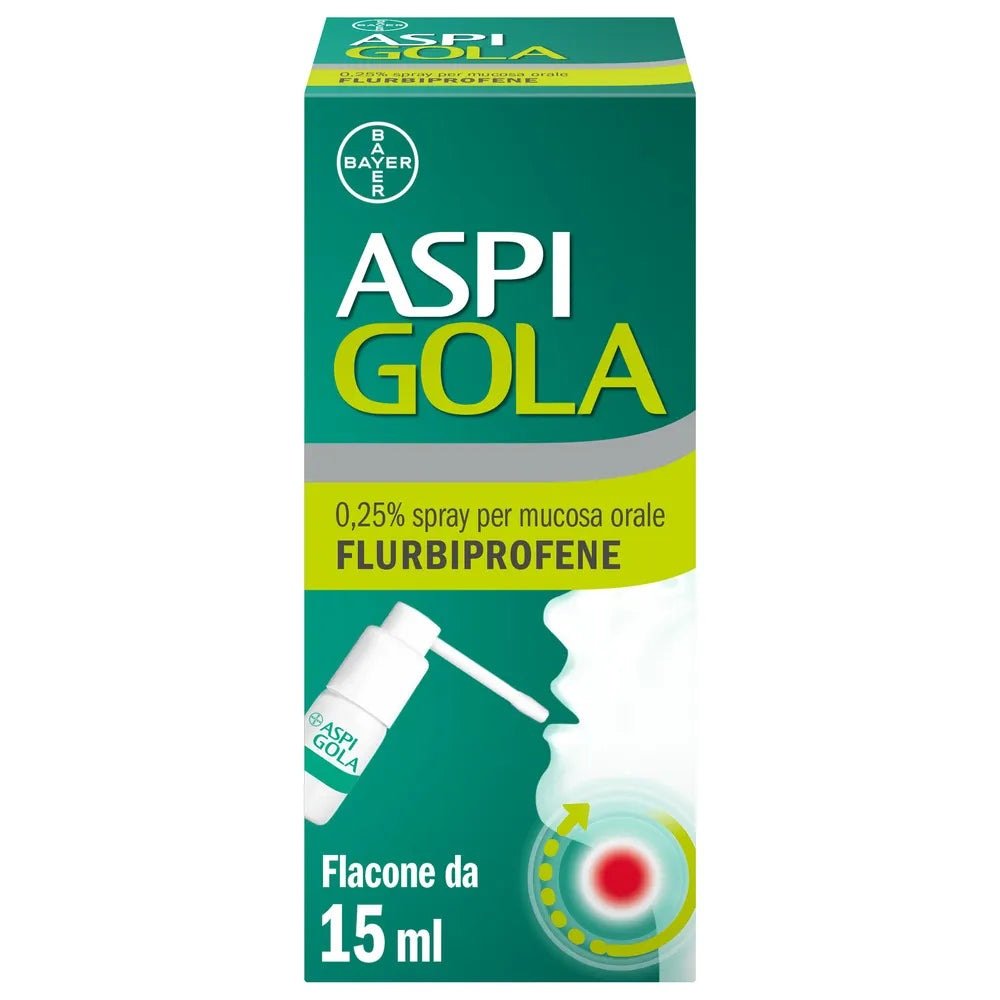
Aspi Sore Throat Painkiller Spray 15 ml 0.25%
Aspi Sore Throat Painkiller Spray 15 ml 0.25%

Aspi Mal di Gola Pain Relief Spray 0.25% is an anti-inflammatory spray based on flurbiprofen indicated for sore throat , mouth and gum pain . It acts quickly with a triple effect against inflammation , pain and difficulty swallowing , ideal for gingivitis , stomatitis and pharyngitis . Suitable for adults and children from 12 years old, with a fresh mint aroma .
Couldn't load pickup availability

NET WEIGHT OF THE PRODUCT
NET WEIGHT OF THE PRODUCT
15ml
EAN
EAN
041513021
MINSAN
MINSAN
041513021
INDICATIONS
ASPI THROAT Mouthwash ASPI THROAT Spray for oral mucosa Symptomatic treatment of irritative-inflammatory states also associated with pain in the oropharyngeal cavity (e.g. gingivitis, stomatitis, pharyngitis), also as a consequence of conservative or extractive dental therapy.
ACTIVE INGREDIENTS
ASPI GOLA 0.25% Mouthwash 100 ml of solution contains: Active ingredient: Flurbiprofen 0.25 g ASPI GOLA 0.25% Spray for oral mucosa 100 ml of solution contains: Active ingredient: Flurbiprofen 0.25 g Excipients with known effects : ethanol 8.64 g methyl p-hydroxybenzoate 0.10 g propyl p-hydroxybenzoate 0.02 g hydrogenated castor oil-40 polyoxyethylene 2.00 g blue patent V dye (E131) 0.0006 g For the full list of excipients, see section 6.1
EXCIPIENTS
ASPI GOLA Mouthwash and ASPI GOLA Spray for oral mucosa Glycerol (98%), ethanol, non-crystallizable liquid sorbitol, hydrogenated castor oil-40 polyoxyethylene, sodium saccharin, methyl parahydroxybenzoate, propyl parahydroxybenzoate, mint flavour, patent blue V (E131), anhydrous citric acid, sodium hydroxide, purified water.
CONTRAINDICATIONS AND SIDE EFFECTS
Flurbiprofen is contraindicated in patients with known hypersensitivity (asthma, bronchospasm, urticaria or allergic type) towards flurbiprofen or to any of the excipients listed in paragraph 6.1, and towards acetylsalicylic acid or other non-steroidal anti-inflammatory drugs (NSAIDs). Flurbiprofen is also contraindicated in patients with a history of gastrointestinal bleeding or perforation related to previous NSAID treatment. Flurbiprofen should not be taken by patients with active or anamnestic ulcerative colitis, Crohn's disease, recurrent peptic ulcer or gastrointestinal bleeding (defined as two or more distinct episodes of demonstrated ulceration or bleeding). Flurbiprofen is contraindicated in patients with severe heart failure. Third trimester of pregnancy
DOSAGE
Undesirable effects can be minimized by using the lowest effective dose for the shortest possible duration of treatment needed to control symptoms (see section 4.4). ASPI THROAT Mouthwash 2-3 rinses or gargles per day with 10 ml (1 measuring spoon) of mouthwash diluted in half a glass of water or pure. ASPI THROAT Spray for oral mucosa 2 sprays 3 times a day aimed directly at the affected part. Each spray delivers 0.2 ml of solution, equivalent to 0.5 mg of active ingredient.
CONSERVATION
This medicinal product does not require any special precautions for storage.
WARNINGS
At the recommended doses, when using the product in its various pharmaceutical forms, any swallowing does not cause any harm to the patient, as the dose of flurbiprofen is widely lower than that commonly used in systemic treatments. Use of the product, especially if prolonged, can give rise to sensitization or local irritation phenomena; in such cases it is necessary to interrupt the treatment and consult the doctor to institute, if necessary, a suitable therapy. In patients with renal, cardiac or hepatic insufficiency the product should be used with caution. It is advisable not to combine the product with other NSAIDs. Cases of bronchospasm have been reported with flurbiprofen in patients with a history of bronchial asthma. Gastrointestinal effects Flurbiprofen should be administered with caution to patients with a history of peptic ulcers and other gastrointestinal diseases as these conditions may be exacerbated. The risk of gastrointestinal haemorrhage, ulcer or perforation is higher with increasing dosage of flurbiprofen in patients with a history of ulcer, particularly if complicated by haemorrhage and perforation, and in the elderly. These patients should start treatment with the lowest available dose. Gastrointestinal bleeding, ulcer or perforation have been reported with all NSAIDs at any time during treatment. These adverse events can be fatal and can occur with or without warning symptoms or in case of a previous history of serious gastrointestinal events. Patients with a history of gastrointestinal disease, especially if elderly, should report any unusual abdominal symptoms (especially gastrointestinal bleeding) in the initial stages of treatment. Elderly patients have an increased frequency of adverse reactions to NSAIDs, especially gastrointestinal bleeding and perforation, which may be fatal. Undesirable effects can be minimized by using the lowest effective dose for the shortest possible duration of treatment needed to control symptoms (see section 4.2). Important information about some excipients ASPI GOLA mouthwash and ASPI GOLA Spray contain para-hydroxybenzoates which can cause delayed allergic reactions, such as contact dermatitis; more rarely they can cause immediate reactions, with urticaria and bronchospasm. The dye patent blue V (E131) may cause allergic reactions. Polyoxyethylene Hydrogenated Castor Oil-40 may cause localized skin reactions. Both the mouthwash and the spray contain a small amount of ethyl alcohol, less than 100 mg per dose. Do not use for prolonged treatments. After short periods of treatment without appreciable results, consult your doctor.
INTERACTIONS
Caution should be exercised in patients treated with any of the medicines listed below, as interactions have been reported in some patients. However, inform your doctor if you are taking other medicines. Aspirin: As with other NSAID-containing medicines, concomitant administration of flurbiprofen and aspirin is generally not recommended due to the potential for increased side effects. Anti-aggregating agents: increased risk of gastrointestinal bleeding. Selective serotonin reuptake inhibitors (SSRIs): increased risk of gastrointestinal bleeding. Corticosteroids: increased risk of gastrointestinal ulcer or bleeding with NSAIDs. Cox-2 inhibitors and other NSAIDs: Concomitant use of other NSAIDs, including selective cyclooxygenase-2 inhibitors, should be avoided due to potential additive effects.
SIDE EFFECTS
The following side effects have been reported, particularly after the administration of formulations for systemic use:Pathologies of the blood and lymphatic system Thrombocytopenia, aplastic anemia and agranulocytosis Immune system disorders Anaphylaxis, angioedema, allergic reaction. Nervous system disorders Dizziness, cerebrovascular accident, visual disturbances, optic neuritis, migraine, paraesthesia, depression, confusion, hallucination, vertigo, discomfort, fatigue and drowsiness. Ear and labyrinth disorders Tinnitus Respiratory, thoracic and mediastinal disorders Respiratory tract reactivity (asthma, bronchospasm and dyspnea) Gastrointestinal disorders The most commonly observed adverse events are gastrointestinal in nature. The following have been reported after administration of flurbiprofen: nausea, vomiting, diarrhoea, flatulence, constipation, dyspepsia, abdominal pain, melena, haematemesis, ulcerative stomatitis, gastrointestinal haemorrhage and exacerbation of colitis and Crohn's disease. Less frequently, gastritis, peptic ulcer, perforation and ulcer bleeding have been observed. Pathologies of the skin and subcutaneous tissue Skin disorders including rash, pruritus, urticaria, purpura and very rarely bullous dermatoses (including Stevens-Johnson Syndrome, Toxic Epidermal Necrolysis and Erythema multiforme). Renal and urinary disorders Nephrotoxicity in various forms, including interstitial nephritis and nephrotic syndrome. As with other NSAIDs, rare cases of renal failure have been reported. Topical use of the product, especially if prolonged, can give rise to sensitization or local irritation phenomena. Reporting of suspected adverse reactions Reporting suspected adverse reactions that occur after authorization of the medicine is important, as it allows continuous monitoring of the benefit/risk balance of the medicine. Healthcare professionals are asked to report any suspected adverse reactions via the national reporting system at www.agenziafarmaco.gov.it/it/responsabili.
OVERDOSE
Given the reduced content of the active ingredient and its local use, it is unlikely that overdose situations may occur. Symptoms Symptoms of overdose may include nausea, vomiting, and gastrointestinal irritation. Treatment Treatment should include gastric lavage and, if necessary, correction of the serum electrolyte picture. There is no specific antidote for flurbiprofen.
PREGNANCY AND BREASTFEEDING
During the first and second trimester of pregnancy, flurbiprofen should not be administered unless strictly necessary. The administration of flurbiprofen is not recommended in breastfeeding mothers.
EFFECTS ON DRIVING ABILITY
It does not interfere with the ability to drive vehicles and use machines.
OUR PRODUCTS FOR THIS SEASON
-
Curial βeta Dry eye supplement 30 capsules Dr.Tili
Vendor:TilpharmaRegular price €22,50Regular priceUnit price per€22,50Sale price €22,50 -
T - Relaxfast Sleep Supplement 60 Capsules Dr.Tili
Vendor:TilpharmaRegular price €24,50Regular priceUnit price per€24,50Sale price €24,50 -
Face Serum C5 Vitamin C 30ml Dr.Tili Skinlab
Vendor:TilabRegular price €62,50Regular priceUnit price per€62,50Sale price €62,50 -
Dr.Tili Skinlab E15 Vitamin E Face Serum 30ml
Vendor:TilabRegular price €32,50Regular priceUnit price per€32,50Sale price €32,50 -
Vit+ Face Vitamin Cream 50ml Dr.Tili Skinlab
Vendor:TilabRegular price €34,00Regular priceUnit price per€34,00Sale price €34,00 -
Anti-aging Facial Treatment Hyaluronic Acid IAL B3 30ml Dr.Tili Skinlab
Vendor:TilabRegular price €46,00Regular priceUnit price per€46,00Sale price €46,00 -
Body Milk Hydra Milk 200Ml. Dr.Tili Skinlab
Vendor:TilabRegular price €16,90Regular priceUnit price per€16,90Sale price €16,90 -
Facial Cleansing Milk 150ml Dr.Tili Skinlab
Vendor:TilabRegular price €18,90Regular priceUnit price per€18,90Sale price €18,90 -
Soothing Facial Toner 125ml Dr.Tili Skinlab
Vendor:TilabRegular price €14,50Regular priceUnit price per€14,50Sale price €14,50 -
Soothing Face Cream 50ml Dr.Tili Skinlab
Vendor:TilabRegular price €19,50Regular priceUnit price per€19,50Sale price €19,50

















-

ASSISTANCE - TELEPHONE ORDERS
-

SHIPPING
Shipping to Italy 24/48H
Delivery also on Saturday and Sunday
Free over €49.90
Shipping to Europe 24/72H
Free over €80 -

SAFETY
The security of your data is important to us!
We strictly comply with the European GDPR regarding
Privacy and processing of personal data
The payments you make on our site are 100% safe and guaranteed -

RETURNS
Fast returns via DIY portal and 14 days to change your mind.
Immediate and free replacements for incorrect or non-compliant products delivered.


