

Viatris Healthcare
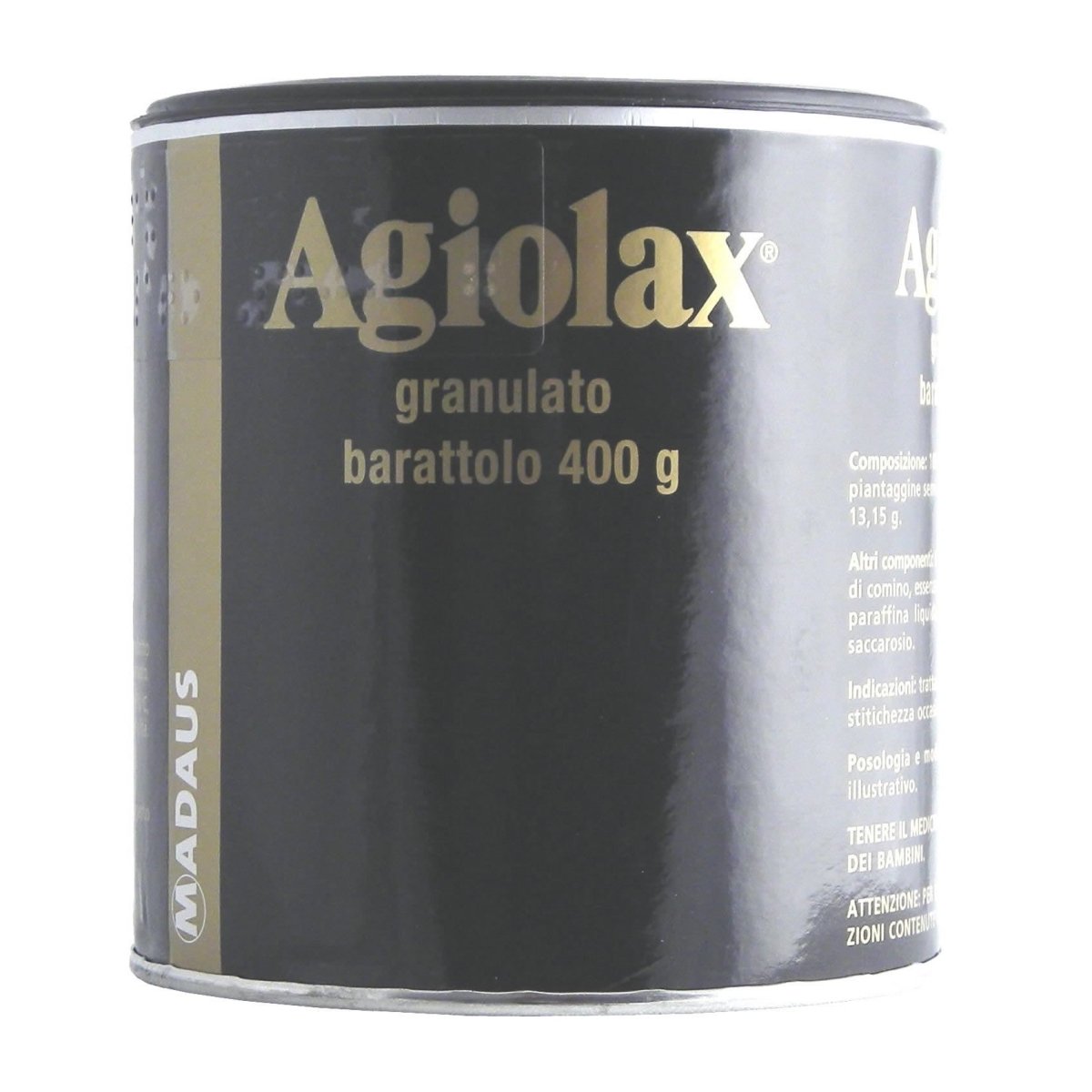
Agiolax granules 400 g pack with measuring spoon
Agiolax granules 400 g pack with measuring spoon

Couldn't load pickup availability

NET WEIGHT OF THE PRODUCT
NET WEIGHT OF THE PRODUCT
400g
EAN
EAN
023714037
MINSAN
MINSAN
023714037
In compliance with article 118 "authorization of advertising to the public" of the legislative decree of 24 April 2006, number 219
INDICATIONS
Short-term treatment of occasional constipation in adults and adolescents over 12 years of age.
CONTRAINDICATIONS
• hypersensitivity to the active substances or to any of the excipients listed in section 6.1 • sudden irregularity of intestinal functions that persists for more than 2 weeks • acute abdominal pain or of unknown origin • nausea or vomiting • intestinal obstruction • esophageal or gastrointestinal stricture • rectal bleeding of unknown origin • failure to defecate following the use of laxatives • severe state of dehydration • dysphagia, hiatal hernia or conditions which pose a risk of regurgitation • atony of the colon • megacolon • faecal impaction • children under 12 years of age • pregnancy and breast-feeding (see section 4.6) • Crohn's disease, ulcerative colitis and appendicitis
WARNINGS AND PRECAUTIONS FOR USE
Warnings Abuse of laxatives (frequent or prolonged use or with excessive doses) can cause persistent diarrhea with consequent loss of water, mineral salts (especially potassium) and other essential nutritional factors. In more severe cases, the onset of dehydration or hypokalemia is possible, which can cause cardiac or neuromuscular dysfunction especially in case of simultaneous treatment with some medicinal products (see section 4.5). The abuse of laxatives, especially contact laxatives (stimulant laxatives), can cause addiction (possible need to progressively increase the dosage), chronic constipation and loss of normal intestinal functions (intestinal atony). During treatment with Agiolax it is necessary to ingest a large quantity of water (6-8 glasses per day) to prevent the onset of intestinal obstruction. Agiolax should be used only if a therapeutic effect cannot be achieved by changing the diet or administering bulking laxatives. The use of laxatives concomitantly with thyroid hormones may make it necessary to adjust the dose of thyroid hormones. Given the risk of gastrointestinal obstruction, Agiolax should not be used together with medicinal products known to inhibit peristaltic movement (see section 4.5). After oral intake or skin contact Agiolax may cause hypersensitivity reactions (see section 4.8). Abdominal pain, spasms and diarrhea may occur, especially in the case of pre-existing irritable bowel syndrome (see section 4.8). These symptoms can also arise following overdose; in this circumstance it is necessary to reduce the dose (see section 4.9). Important information about some excipients Agiolax contains sucrose: patients suffering from rare hereditary problems of fructose intolerance, glucose-galactose malabsorption, or sucrase isomaltase insufficiency should not take this medicine.
INTERACTIONS
Hypokalaemia (resulting from long-term abuse of laxatives) potentiates the effects of cardiac glycosides and interacts with antiarrhythmic medicinal products, medicinal products that induce sinus rhythm reversal (e.g. quinidine) and medicinal products that induce QT prolongation. Concomitant use of diuretics, corticosteroids and licorice root may increase electrolyte imbalance. Laxatives can reduce the residence time in the intestine, and therefore the absorption, of other drugs administered simultaneously orally (e.g. vitamin B12, coumarin derivatives, lithium and carbamazepine). Concomitant administration of antidiabetics may increase the risk of hypoglycemia. Avoid ingesting laxatives and other medicines at the same time: leave an interval of at least 2 hours before or after taking the laxative and another medicine. Agiolax may potentiate the risk of occlusion from opioid-induced reduced peristalsis (see section 4.4).
SIDE EFFECTS
Side effects are reported according to system organ class according to MedDRA. Undesirable effects are listed using the MedDRA frequency convention: very common (≥1/10); common (≥1/100, <1/10); uncommon (≥ 1/1000, < 1/100); rare ≥ 1/10,000, < 1/1000); very rare (<1/10,000); not known (frequency cannot be estimated from the available data). Undesirable effects are presented in order of decreasing severity.
System organ class according to MedDRA | Rare (≥ 1/10,000, ≤ 1/1,000) | Very rare (≤1/10,000) | Not known
Gastrointestinal disorders | Rare (≥ 1/10,000, ≤ 1/1,000): Abdominal colic*, Flatulence, Abdominal distension, Gastrointestinal obstruction, Fecal impaction | Very rare (≤1/10,000): Obstruction of the esophagus | Not known: Nausea, Vomiting, Diarrhoea
Renal and urinary disorders | Rare (≥ 1/10,000, ≤ 1/1,000): Chromaturia*** | Not known: Albuminuria**, Hematuria**
Immune system disorders | Not known: Hypersensitivity reactions, Anaphylactic reactions, Rash, Pruritus
*more frequently in case of severe constipation or irritable bowel syndrome; ** from prolonged use; *** this coloring is due to the presence of senna components in the urine and is not clinically significant. Furthermore, melanosis of the colon which recedes after discontinuation of the medicinal product has been reported. Reporting of suspected adverse reactions Reporting suspected adverse reactions that occur after authorization of the medicine is important, as it allows continuous monitoring of the benefit/risk balance of the medicine. Healthcare professionals are asked to report any suspected adverse reactions via the national reporting system at: https://www.aifa.gov.it/content/segnalazioni-reazioni-avverse.
OUR PRODUCTS FOR THIS SEASON
-
Curial βeta Dry eye supplement 30 capsules Dr.Tili
Vendor:TilpharmaRegular price €18,00Regular priceUnit price per€22,50Sale price €18,00Sale -
T - Relaxfast Sleep Supplement 60 Capsules Dr.Tili
Vendor:TilpharmaRegular price €19,60Regular priceUnit price per€24,50Sale price €19,60Sale -
Face Serum C5 Vitamin C 30ml Dr.Tili Skinlab
Vendor:TilabRegular price €50,00Regular priceUnit price per€62,50Sale price €50,00Sale -
Dr.Tili Skinlab E15 Vitamin E Face Serum 30ml
Vendor:TilabRegular price €26,00Regular priceUnit price per€32,50Sale price €26,00Sale -
Vit+ Face Vitamin Cream 50ml Dr.Tili Skinlab
Vendor:TilabRegular price €27,20Regular priceUnit price per€34,00Sale price €27,20Sale -
Anti-aging Facial Treatment Hyaluronic Acid IAL B3 30ml Dr.Tili Skinlab
Vendor:TilabRegular price €36,80Regular priceUnit price per€46,00Sale price €36,80Sale -
Body Milk Hydra Milk 200Ml. Dr.Tili Skinlab
Vendor:TilabRegular price €13,52Regular priceUnit price per€16,90Sale price €13,52Sale -
Facial Cleansing Milk 150ml Dr.Tili Skinlab
Vendor:TilabRegular price €15,12Regular priceUnit price per€18,90Sale price €15,12Sale -
Soothing Facial Toner 125ml Dr.Tili Skinlab
Vendor:TilabRegular price €11,60Regular priceUnit price per€14,50Sale price €11,60Sale -
Soothing Face Cream 50ml Dr.Tili Skinlab
Vendor:TilabRegular price €15,60Regular priceUnit price per€19,50Sale price €15,60Sale
















-

ASSISTANCE - TELEPHONE ORDERS
-

SHIPPING
Shipping to Italy 24/48H
Delivery also on Saturday and Sunday
Free over €49.90
Shipping to Europe 24/72H
Free over €80 -

SAFETY
The security of your data is important to us!
We strictly comply with the European GDPR regarding
Privacy and processing of personal data
The payments you make on our site are 100% safe and guaranteed -

RETURNS
For returns, contact our customer service: you have 14 days to change your mind.
Immediate, free replacement of wrong or non-conforming products.


